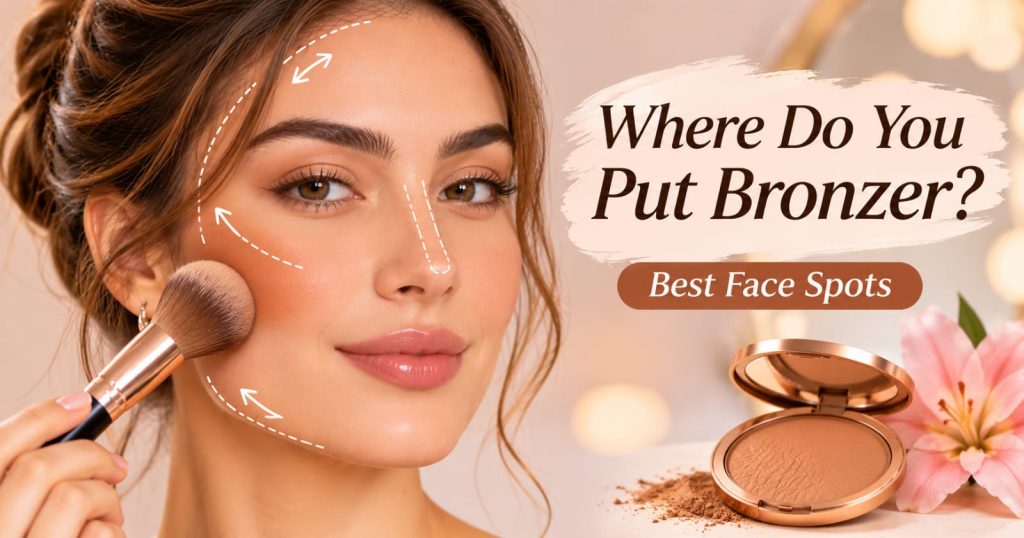
You swirl a brush into bronzer, lean toward the mirror, and suddenly you’re not sure what to do next. Cheeks? Forehead? All over? It’s an easy product to get wrong, and a heavy hand can leave you looking muddy or orange instead of sun-kissed. So, where do you put bronzer for a natural, flattering look?
The short answer is wherever the sun would hit your face first. That means the upper cheeks, temples, forehead edges, and bridge of the nose. From there, you can adjust for face shape, skin type, and how defined you want your makeup to look.
This guide covers exact placement for each area, natural versus sculpted bronzing, a beginner routine, and how bronzer works with blush and highlighter. You’ll also get shade tips and fixes for common problems.
Quick Answer: Where Does Bronzer Go?
So where do you put bronzer for simple everyday warmth? Sweep it across the tops of your cheekbones, along the temples, and lightly around the hairline. Add a touch on the bridge of your nose if you like.
Everything else is optional. Jawline, chin, neck, and collarbones can all take a little bronzer, but you only need them for a more polished, blended or sculpted look.
Where Do You Put Bronzer on Your Face? The 7 Best Spots
Here are seven placements, from most important to optional. For each one you’ll see where it goes, how to apply it, and what it does.
- Cheekbones
Start with the upper part of your cheekbones, the area that catches the sun. Smile and look for the highest point, then sweep bronzer from the outer edge of your cheek back toward your ear.
Use a large, fluffy brush and keep the stroke light. This adds warmth and a healthy, outdoorsy look without looking like a stripe.
- Temples
Extend the color up from your cheekbones into your temples. The goal is to connect your cheeks to your forehead so the warmth looks continuous.
Use whatever is left on your brush, and blend in small circles. Too much here can look like a dark patch, so build slowly.
- Forehead and Hairline
Sweep a little bronzer along the upper edge of your forehead, just where your hairline starts. A thin, soft band is enough.
This frames the face and ties the whole look together. If you have a high or broad forehead, a little extra can make it look softer and more balanced.
- Nose Bridge
Use the tiniest amount of bronzer across the bridge of your nose, like a light dusting from a day outside. Then stop.
This is the easiest spot to overdo. If your nose tends to shine or you want a cleaner look, you can skip it.
- Jawline
Sweep a bit of bronzer along the edge of your jaw, and blend it down into your neck. The key is to avoid a visible line.
It helps your face and neck look like one color, especially if your foundation is a shade or two different from your neck.
- Neck and Ears
Take any leftover bronzer and blend it onto your neck and the tops of your ears. It’s a small step that makes everything look even.
Skipping this is a common mistake. If your face is warm and your neck is pale, the contrast can look obvious.
- Collarbones and Chest (Optional)
For summer or evening looks, you can blend a little bronzer onto your collarbones and the top of your chest. Use a light touch and plenty of blending.
This is purely optional. It adds a cohesive, sun-warmed look when your neckline shows.
A Few Other Optional Spots
You can also tap a small amount on your chin for balance. Some formulas can double as a soft eyeshadow, which makes for a quick, monochrome look.
Quick Placement Guide
| What you want | Where to place it |
| Everyday warmth | Upper cheekbones and temples |
| A sun-kissed look | Cheekbones, forehead edges, nose bridge |
| An even complexion | Jawline, neck, and ears |
| A framed face | Temples and hairline |
| A seasonal glow | Collarbones and chest |
Natural Bronzing vs. Sculpted Placement
Where do you put bronzer? It depends on the look you want. Natural bronzing and sculpted bronzing both use the same product, but they put it in different places.
**Natural bronzing** copies where the sun would tan you: the top of the cheekbones, temples, nose, and hairline. It’s soft, warm, and very blendable.
**Sculpted bronzing** goes a step further. It places color in the hollows beneath the cheekbones, and sometimes along the jaw, to create a shadow that adds definition. It works best with a matte formula and careful blending.
You don’t have to pick one forever. Natural bronzing is great for daytime, while a sculpted version can work for evenings or photos.
Bronzer vs. Contour: What’s the Difference?
People often use the two terms as if they’re the same, but they do different jobs.
| Bronzer | Contour | |
| Purpose | Adds warmth and a sun-kissed look | Creates the look of shadow and definition |
| Undertone | Warm | Neutral to cool |
| Placement | Where the sun hits: cheeks, temples, nose, hairline | In hollows, along the jaw, and beside the nose |
| Finish | Matte, satin, or shimmery | Usually matte |
Neither product physically changes the shape of your face. They create illusions with color. If you want something simple, bronzer alone can give a soft, easy version of definition, and many people prefer it.
Many makeup artists use both. In that case, contour goes on first to shape, and bronzer goes on top to warm.
Where to Put Bronzer Based on Your Face Shape
Where do you put bronzer on different face shapes? These are ideas, not rules. Use them as starting points, and adjust for what you like.
Round Face
Apply bronzer along the temples and just below the cheekbones, angled up toward your ear. This adds a little definition around the edges while keeping the center soft.
Oval Face
Oval faces are naturally balanced, so the standard placements work well. Warm the cheekbones, temples, and hairline, and add the rest as you like.
Square Face
To soften strong corners, blend bronzer at the outer corners of your forehead and jaw using soft, rounded strokes. Keep the edges of the color diffuse.
Heart-Shaped Face
Heart shapes have a wider forehead and a narrower chin. Place a little extra at the temples and upper forehead to balance the width, and add a light touch along the jaw.
Diamond Face
With wide cheekbones, keep bronzer light on the cheeks. Focus on the temples and the corner of the jaw for balance.
Long or Rectangular Face
Apply bronzer horizontally, along the hairline and just under the chin, to make the face look a little shorter. Avoid long, vertical strokes down the cheeks.
How to Apply Bronzer for Beginners
If you’re new to all this, the easiest way to learn where do you put bronzer is to follow a simple routine. Start small and build up slowly.
Step 1: Prep Your Base
Apply your foundation and concealer first. If you’ll use a powder bronzer over a cream or liquid base, set your skin lightly with a thin layer of translucent powder.
Step 2: Choose a Formula
Powder is the easiest to control, so it’s a good starting point. Cream and liquid are more forgiving on dry skin but need quick blending.
Step 3: Find Your Placement Areas
Smile and look in the mirror. Find the highest part of your cheekbone, your temples, and your hairline. Those are your starting points.
Step 4: Use a Small Amount
Dip your brush lightly, then tap off the excess. It’s always easier to add more than to take it away.
Step 5: Blend Outward
Sweep bronzer from the outer edge of your face inward, then blend in small circles. Blending toward the center of your face can leave color in the wrong place, so keep the motion outward.
Step 6: Check Both Sides in Natural Light
Look at your face near a window. Compare both sides, and fix anything uneven. Build color gradually until you like it.
Best Brushes and Tools
For powder, use a large, fluffy brush with flexible bristles and sweep in light circles. For cream, a damp sponge or a dense brush presses and blends the color well, and a small brush helps at the temples. Wash your tools regularly so color stays clean and blends smoothly.
The 3-Shape Method
A popular beginner trick is the “3” method. Starting at the temple, sweep down the cheekbone, then toward the jaw, so your strokes form a “3” on each side of your face. It covers the main areas in one smooth motion.
It’s a helpful guide, not a universal rule. Some faces and looks work better with just the cheekbones and temples, and you can skip the jaw for a more natural finish.
Where to Put Bronzer With Blush and Highlighter
Where do you put bronzer when you’re also using blush and highlighter? Think of it as three layers, each with its own zone.
Bronzer goes on the outer edges of the face, where the sun hits. Blush goes on the apples of the cheeks, and highlighter goes on the tops of the cheekbones, just above the blush.
Many people apply bronzer first, then blush, then highlighter, so color builds from warm to bright. Blend where the products meet so there’s no hard line. If you use cream products, follow the same order, and use less of each to keep cheeks from looking heavy.
How to Choose the Right Bronzer Formula
The formula you pick affects how bronzer applies, wears, and blends. Here’s how they compare.
| Formula | Best for | Notes |
| Powder | Beginners, oily or combination skin | Easy to control, apply with a fluffy brush |
| Cream | Dry or normal skin, a skin-like finish | Blend with a damp sponge or dense brush |
| Liquid | Sheer, natural color, mixing with foundation | A few drops go a long way |
| Stick | Quick, precise application | Dot on, then blend |
The best formula depends on your skin and your preference. Cream isn’t automatically better for dry or mature skin, and powder isn’t automatically better for oily skin, so test what works for you.
How to Choose a Bronzer Shade
Shade is where a lot of people go wrong. A shade that’s too orange, too red, or too dark can look unnatural, even if you put it in exactly the right place.
Lighter or Darker?
A good rule is to choose a bronzer that looks like a natural tan on you, usually a shade or two deeper than your skin. It should look like a little extra sun, not like a different skin tone.
Skin Tone vs. Undertone
Skin tone is how light or deep your skin is, and undertone is the subtle warm, cool, or neutral hue beneath it. They’re different, so two people with the same depth can need different shades.
- **Warm or golden undertones:** Golden or caramel bronzers tend to look natural
- **Cool or pink undertones:** Soft, neutral, or rosy-brown bronzers can look more flattering
- **Neutral undertones:** Most shades work, so choose by depth and finish
If your bronzer looks orange, try a shade with less red. If it looks muddy or gray, try a warmer shade. People with deep skin tones can look for ranges that include rich, golden, and reddish-brown bronzers instead of pale tan colors.
How to Apply Bronzer for Different Skin Types and Mature Skin
Skin type changes which formula and finish look best. These tips focus on how it looks, not on treating skin concerns.
**Oily skin:** Powder usually wears best. Keep the nose and forehead light. Note that a matte bronzer can reduce surface shine, but it doesn’t change how much oil your skin produces.
**Dry skin:** Cream or liquid formulas often look smoother. Moisturize well first, and blend quickly.
**Combination skin:** Use powder on the T-zone and cream on drier areas.
**Sensitive skin:** Choose fragrance-free formulas, and patch test new products on your inner arm.
**Mature skin:** Age isn’t a skin type, so choose by texture and dryness. Use a light hand, press color in instead of dragging it, and choose a finely milled formula with minimal shimmer so it doesn’t settle into lines.
Should You Apply Bronzer Before or After Foundation?
Where do you put bronzer in your routine order? It depends on the formula, so here’s a simple guide.
- **Powder bronzer:** Goes over foundation. If you wear cream or liquid foundation, set it lightly with translucent powder first.
- **Cream bronzer:** Goes over cream or liquid foundation, before any powder. Don’t layer cream over powder, since it can get patchy.
- **Liquid bronzer:** Can be mixed into foundation or applied after it, and set with powder if you like.
If you use powder foundation, a powder bronzer is the easiest match. And yes, you can wear bronzer without foundation. Just moisturize first and use a sheer formula.
Bronzer and Sun Safety
Before you decide where do you put bronzer, remember what it can and can’t do. Bronzer adds color to your skin, but it doesn’t protect it from the sun. A bronzed look can make skin appear tanned without giving you any protection.
Dermatologists, including the American Academy of Dermatology, say makeup with SPF isn’t enough on its own. Apply a real sunscreen first, then your makeup on top, and reapply sunscreen when you’re outdoors.
Common Bronzer Mistakes and How to Fix Them
Even if you’re sure where do you put bronzer, it can still look off, and one of these is usually the cause.
| Problem | Fix |
| Looks orange | Switch to a shade with less red, or use less |
| Looks muddy | Try a warmer, lighter shade |
| Cheeks look too dark | Use a lighter hand and blend more |
| Visible line at the jaw | Blend down onto the neck |
| Looks patchy | Check your base and formula compatibility |
| Emphasizes texture | Use a finer formula and less product |
| Fades or looks uneven | Set the base first and build in thin layers |
Do You Need Bronzer Everywhere?
No. Many everyday looks only need the cheekbones and temples. Add the forehead, nose, and jaw for a fuller bronzed look, and skip any area you don’t want to emphasize.
Even when you know where do you put bronzer, less is usually more. A soft, well-blended glow looks more natural than a heavy application.
Frequently Asked Questions
Where Do You Put Bronzer for Beginners?
Start with the tops of your cheekbones and your temples. Blend outward, build gradually, and add the forehead and jawline once you’re comfortable.
Where is the correct place to put bronzer?
There’s no single place. The classic spots are the upper cheekbones, temples, hairline, and nose bridge, with the jaw and neck as blending areas.
Is it better to contour or bronze?
It depends on your goal. Bronzer adds warmth, and contour adds definition. Many people choose bronzer for everyday and add contour for special occasions.
Is bronzer applied before or after foundation?
After. Powder bronzer goes over foundation, and cream bronzer goes over cream or liquid foundation before powder.
Do you go lighter or darker with bronzer?
Choose a shade that looks like your natural tan, usually a shade or two deeper than your skin. Avoid shades that look orange or muddy.
Should bronzer go on the forehead?
Yes, lightly, along the hairline. This helps your face look even and balanced, but it’s optional.
Can you use bronzer without foundation?
Yes. Moisturize first, and use a sheer cream or lightly pigmented powder.
How do you apply a bronzer stick?
Dot it on the cheekbones, temples, and hairline, then blend quickly with a sponge or brush before it sets.
Final Thoughts
Knowing where do you put bronzer is easier than it seems: cheekbones and temples first, then the hairline, nose, and jaw if you want more. Adjust for your face shape, choose a shade that looks like a natural tan, and blend well.
Start with a little, and build gradually. A soft, sun-kissed glow looks best when it looks like you just spent a nice afternoon outdoors.
If you want to read more about this, check out our detailed guide here:https://zaisufbeauty.com/skincare-for-saggy-skin/