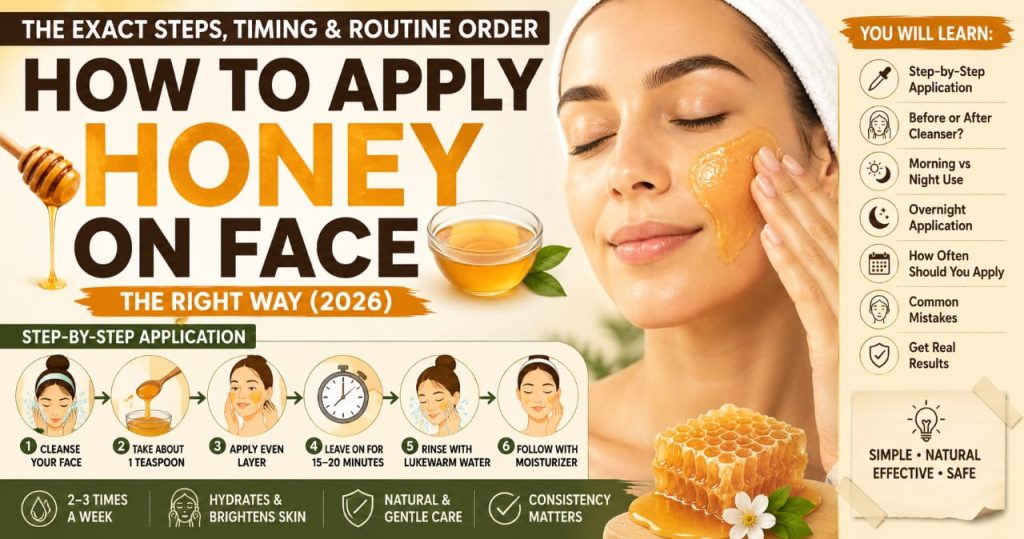
Most guides on how to apply honey on face stop at “wash your face, apply honey, wait, rinse,” which leaves out the details that actually determine whether you get good results or just sticky, disappointing ones. The exact quantity, timing, routine order, and what to do afterward all matter more than people expect.
This guide covers the full process: exactly how much honey to use, whether to apply it before or after your other skincare steps, morning versus night timing, overnight use, and what’s likely going wrong if you’ve tried it without seeing results. For honey type comparisons, mixing recipes, and the truth about
whitening claims, see our companion guide on how to use honey for skin whitening.
Many beginners search for how to apply honey on face because they want a simple, natural skincare routine that is easy to follow at home. Following the correct steps helps you get the best results while avoiding common mistakes.
Table of Contents
- Quick Answer
- Exact Step-by-Step Application
- Before or After Cleanser?
- Where Honey Fits in Your Skincare Routine
- Morning vs Night Application
- How to Apply Honey Overnight
- How Often Should You Apply It
- Why Am I Not Seeing Results?
- Common Application Mistakes
1 0. Frequently Asked Questions
1 1 . Final Thoughts
Quick Answer
Apply honey on face by cleansing first, then spreading a thin, even layer of raw honey over dry or slightly damp skin using clean fingers, avoiding the eye area. Leave it on for 1 5 to 20 minutes, rinse with lukewarm water, then follow with your regular moisturizer and, during the day, sunscreen. Two to three times a week is generally enough; daily use isn’t necessary and overnight use should be
occasional rather than routine.
If you’re wondering how to apply honey on face for the best results, always start with clean skin, use a thin layer of raw honey, and rinse it off after 15–20 minutes before applying moisturizer.
Exact Step-by-Step Application
- Cleanse your face. Start with a clean face, free of makeup, sunscreen, or the day’s buildup, so the honey makes direct contact with your skin.
- Measure about one teaspoon. This is generally enough to cover the full face without excessive dripping or waste.
- Apply with clean fingers, not a brush. Fingers give you more control over spreading a thin, even layer, and honey’s texture doesn’t require a brush the way liquid products do.
- Spread in light, even strokes. Cover your forehead, cheeks, nose, and chin, avoiding the delicate eye area, where skin is thinner and more prone to
irritation.
- Leave it on for 1 5 to 20 minutes. This is enough time for the honey to hydrate the skin without needing to sit for hours.
- Rinse with lukewarm water. Hot water can be drying, and very cold water won’t dissolve the honey as easily. Gently massage in circular motions as you rinse to help lift away loosened dead skin.
- Pat dry, don’t rub. Rubbing can irritate skin that’s just been treated.
- Follow with moisturizer. This locks in the hydration honey has provided.
- Learning how to apply honey on face correctly makes a noticeable difference. A thin, even layer and the right application time are more effective than using too much honey.
Before or After Cleanser?
Honey should go on after cleansing, not before. Applying it to unwashed skin means it’s working over a layer of dirt, oil, or leftover product, which reduces how
well it can actually contact and hydrate your skin. Cleanse first, pat your face dry (or leave it slightly damp, both work), and then apply the honey directly.
Where Honey Fits in Your Skincare Routine
A honey mask functions as a treatment step, not a daily product like moisturizer.
The general order looks like this:
Cleanser → Honey mask → Rinse → Toner (optional) → Moisturizer →
Sunscreen (daytime only)
Honey isn’t typically layered underneath serums or other active ingredients in the same session, since it’s meant to be rinsed off rather than left on as part of your regular layering routine. Think of it as an occasional mask step, applied on the days you use it, rather than a daily routine addition like your moisturizer or sunscreen.
Morning vs Night Application
Morning application works well if you want the immediate hydration and mild glow honey provides before starting your day, though you’ll still need to follow with your regular moisturizer and sunscreen afterward, which adds a few extra minutes to your routine.
Night application is often more practical, since you have more time to let the honey sit without rushing, and you can follow it with your nighttime moisturizer without worrying about sunscreen afterward.
Neither timing is inherently better for results, honey works the same way
regardless of time of day. It mostly comes down to which fits your schedule more comfortably.
If you are learning how to apply honey on face, remember that both morning and night routines can work well. The most important factor is following the correct steps consistently
How to Apply Honey Overnight
Leaving honey on overnight is something people frequently search for, but it’s worth doing occasionally rather than as a regular habit. If you choose to do it:
- Apply a thin layer as usual, keeping it lighter than you would for a 1 5-20
minute mask, since a thick layer left overnight is more likely to transfer onto
your pillowcase.
- Consider using a clean pillowcase or a light cloth barrier, since honey can be messy over several hours.
- Rinse thoroughly in the morning with lukewarm water.
- Don’t do this nightly. Occasional overnight use, once every week or two at most, is a reasonable approach; nightly overnight application isn’t necessary for benefit and increases the chance of skin feeling sticky or attracting dirt over an extended period.
For most people, a standard 1 5-20 minute application achieves similar hydration benefits without the mess or extended exposure time.
How Often Should You Apply It
Two to three times a week is a reasonable, sustainable frequency for most skin types. This gives your skin consistent exposure to honey’s hydrating and gentle exfoliating properties without the marginal, unnecessary benefit of daily use. If you have sensitive skin, starting with once a week and monitoring how your skin responds is a reasonable, cautious approach.
If you are wondering how to apply honey on face for the best results, consistency matters more than daily use. Applying honey two to three times a week is enough for most skin types.
Why Am I Not Seeing Results?
This is one of the most common frustrations people run into, and it usually comes down to one of a few things:
Your expectations may be mismatched with what honey actually does. Honey supports hydration and a brighter, more even-looking complexion over time, it isn’t a fast-acting treatment for significant issues like deep hyperpigmentation or
active acne. If you’re expecting dramatic overnight change, the disappointment often comes from the expectation rather than the product.
You may not be using it consistently enough. A single application, or occasional use once every few weeks, isn’t enough to notice a meaningful difference. Two to three times weekly for at least a few weeks is a more realistic timeline before evaluating whether it’s working for you.
You might be using processed honey instead of raw. Heavily processed, filtered honey has fewer of the natural enzymes and beneficial compounds that make raw honey more effective for skin, so the type of honey you’re using matters.
Your skin type may need a different approach. Very dry skin might benefit from pairing honey with a richer ingredient, while oily skin might see better results from a lighter application frequency. Our companion guide on honey for skin whitening breaks down recommended combinations by skin type in more detail.
On the acne question specifically: research on honey’s ability to actually treat or reduce acne is mixed, and at least one major medical reference source notes that applying honey to the face doesn’t meaningfully help treat acne, despite honey’s antibacterial properties being frequently cited as a reason it should. If acne is your primary concern, it’s worth treating honey as a gentle, hydrating addition to your routine rather than expecting it to function as an acne treatment.
Many people search for how to apply honey on face but make small mistakes like using too much honey or skipping moisturizer after rinsing. A simple routine usually gives the best results
Common Application Mistakes
Using dirty fingers to apply it — this introduces bacteria to freshly cleansed skin and undermines any hygienic benefit honey might otherwise offer
Applying too thick a layer — a thin, even layer is enough; excess honey just means more mess without more benefit
Skipping the patch test — even natural ingredients like honey can trigger allergic reactions, particularly in people with existing bee product allergies
Applying to unwashed skin — this reduces effectiveness by trapping honey over dirt, oil, or leftover product
Using low-quality, heavily processed honey — squeeze-bottle grocery store honey has fewer beneficial properties than raw honey
Expecting fast, dramatic results — honey works gradually with consistent use, not as an instant fix
Knowing how to apply honey on face the right way helps you avoid common mistakes such as using too much honey, leaving it on for too long, or skipping moisturizer after rinsing.
Frequently Asked Questions
Can I apply honey directly on my face?
Yes, raw honey can generally be applied directly to clean skin, though a patch test is recommended first, particularly if you have sensitive skin or known allergies.
Should I wash my face before applying honey?
Yes, always cleanse first. Applying honey to unwashed skin reduces how effectively it can hydrate and work on the skin’s surface.
How long should I leave honey on my face?
1 5 to 20 minutes is generally sufficient for a standard application.
Can I leave honey overnight?
You can occasionally, but it isn’t necessary for benefit and can be messy. A standard 1 5-20 minute application achieves similar results for most people.
Can I apply honey every day?
You can, but it isn’t necessary. Two to three times a week is generally enough for noticeable benefits.
Should I moisturize after using honey?
Yes, following with your regular moisturizer helps lock in the hydration honey has provided.
Does honey clog pores?
Honey itself is not typically pore-clogging, though leaving it on too long without properly rinsing, or not cleansing thoroughly afterward, could contribute to
buildup over time.
Is honey good for acne?
The evidence here is mixed. While honey has antibacterial properties, at least one major medical source specifically notes that applying it to the face doesn’t
meaningfully help treat acne, so it’s worth treating it as a gentle, hydrating addition rather than a dedicated acne treatment.
Can I apply raw honey directly, or does it need to be diluted?
Raw honey can generally be applied directly without dilution for most people, though those with very sensitive skin may prefer to patch test carefully first.
What’s the best time of day to apply honey?
There’s no meaningful difference in results between morning and night application; it mostly comes down to which fits better into your routine.
Should sunscreen be applied over honey residue?
Always rinse honey off completely before applying sunscreen or moving on with your day; it’s meant to be rinsed as a treatment step, not left on underneath other products.
Why does my skin feel sticky after using honey?
This usually means it wasn’t rinsed thoroughly enough. Rinse with lukewarm water and gently massage the skin to fully remove any residue.
For more evidence-based skincare information, you can also read the American Academy of Dermatology (AAD) and MedlinePlus. These trusted medical resources provide guidance on healthy skincare routines, skin conditions, and safe use of natural ingredients.
Final Thoughts
How you apply honey on face matters just as much as the honey itself. Cleansing first, using a thin layer for 1 5 to 20 minutes, rinsing thoroughly, and following with moisturizer covers the fundamentals, while sticking to two to three uses a week and being realistic about the gradual timeline helps avoid the most common source of disappointment.
Now you know how to apply honey on face safely, when to use it, and how to include it in your skincare routine for the best possible results.
For honey type comparisons, specific mixing recipes, and an honest look at whitening claims, check out our companion guide on how to use honey for skin whitening.
This complete guide on how to apply honey on face explains the correct routine, timing, and aftercare so you can use honey safely and effectively as part of your skincare routine.
Disclaimer: This article is for general informational purposes. Individual skin reactions vary, and a patch test is recommended before trying any new ingredient. If you have a known honey or bee product allergy, or a diagnosed skin condition, consult a dermatologist before use.