This post may contain affiliate links. If you purchase through a link on this page, we may
earn a small commission at no extra cost to you.
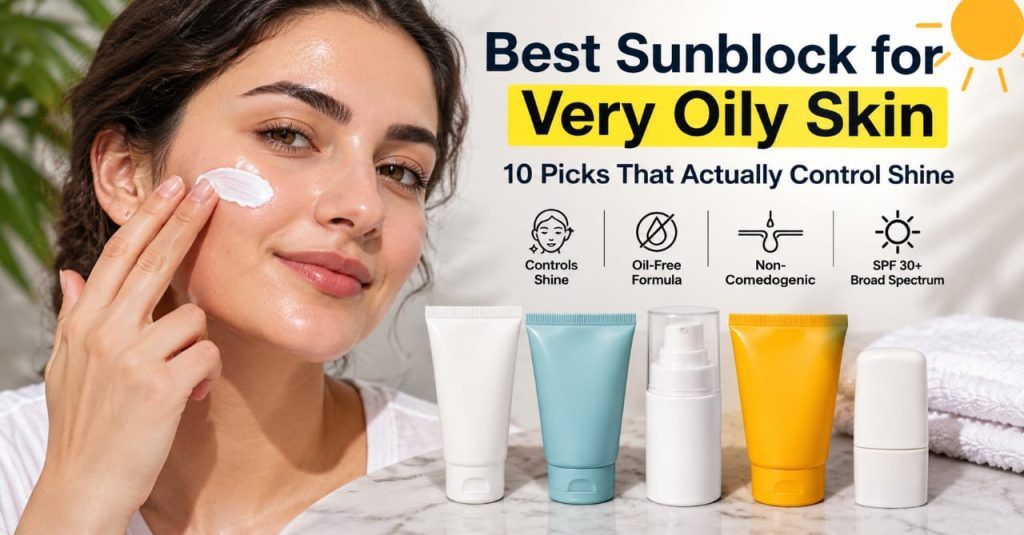
The best sunblock for very oily skin needs to do more than provide sun protection—it should help control shine, feel lightweight, and stay comfortable throughout the day.
This guide focuses specifically on sunblock for very oily skin — the kind that gets shiny fast, breaks down makeup by lunch, and makes most “lightweight” formulas feel heavy within an hour. If your skin is only moderately oily, our broader guide to the best sunscreen for oily skin covers a wider range of finishes and skin concerns. This one is for the shinier end of the spectrum specifically. Recommendations here are based on published formulation details, ingredient analysis, and patterns across verified customer feedback rather than in-person lab testing, so treat performance claims as a strong starting point rather than a guarantee for every skin type.
Table of Contents
- Quick Answer
- Comparison Table
- How We Chose These Products
- Top 1 0 Sunblocks for Oily Skin
- How to Choose the Best Sunblock for Oily Skin
- Ingredients That Help Oily Skin
- Ingredients and Formula Features to Consider
- How to Wear Sunblock Under Makeup
- How to Reapply Without Looking Greasy
1 0. Can Sunscreen Make Oily Skin Worse?
1 1 . Which Sunblock Is Right for You?
1 2. Frequently Asked Questions
1 3. Final Verdict
Quick Answer
For very oily skin specifically, prioritize a gel or fluid formula with a genuine matte finish and oil-absorbing ingredients like silica over anything marketed simply as “lightweight.” If you’re also acne-prone, add non-comedogenic and fragrance-free to that list. If you wear makeup daily, a fast-absorbing, primer-like fluid will pill less than a heavier lotion. And regardless of how oily your skin is, SPF 30 or higher with broad-spectrum protection is the non-negotiable baseline — formula and finish matter more for very oily skin than chasing the highest SPF number on the shelf.
What Makes “Very Oily” Different From Regular Oily Skin
Most sunscreen advice treats oily skin as one category, but there’s a real difference between skin that gets a little shiny by afternoon and skin that’s visibly shining within an hour of application. Very oily skin typically:
Shows noticeable shine within one to two hours, even after blotting Struggles to hold makeup in place through the day without visible breakdown Feels uncomfortable or heavy in formulas that work fine for “normal” oily skin
Often needs a genuinely matte, oil-absorbing finish rather than just an “oil-free” label
This is why a formula that works for mild oiliness can still feel greasy on very oily skin — the two aren’t interchangeable, and shopping for “oily skin” sunscreen in general can lead to disappointing results if your skin sits at the more extreme end.
Comparison Table
Sunblock | Best For | SPF | Finish | Oil-Free | Non-Comedogenic | WhiteCast | |
| Overall MatteFluid | Best Overall | SPF50 | Matte | Yes | Yes | N/A | |
| Ultra-Light Oil-Control Gel | Very Oily Skin | SPF50 | Matte | Yes | Yes | N/A |
Sunblock | Best For | SPF | Finish | Oil-Free | Non-Comedogenic | WhiteCast | |
| Budget Mattifying Sunblock | Budget/Drugstore | SPF50 | Matte | Yes | Yes | N/A | |
| Non-Comedogenic Acne Formula | Acne-Prone Skin | SPF46 | Natural | Yes | Yes | N/A | |
| Featherweight Water-Based Fluid | Lightweight/Water-Based | SPF50 | Natural | Yes | Yes | N/A | |
| Under-Makeup Primer Fluid | Under Makeup | SPF40 | Satin | Yes | Good | N/A | |
| Sheer Transparent Formula | No White Cast | SPF45 | Natural | Yes | Yes | VeryLow | |
| Tinted DeepSkin Formula | Deep Skin Tones | SPF45 | Natural | Yes | Yes | None | |
| Sweat-Resistant Sport Formula | Sweat/OutdoorUse | SPF50 | Matte | Yes | Good | N/A | |
| Humidity-Proof Gel | Hot/HumidWeather | SPF50 | Matte | Yes | Yes | N/A |
How We Chose These Products
This list wasn’t built by personally lab-testing every formula. Instead, every sunblock was evaluated using:
Published ingredient lists and formulation type (mineral, chemical, or hybrid)
Broad-spectrum protection and SPF level
Patterns across verified customer reviews specifically mentioning oiliness, shine, breakouts, and white cast
Non-comedogenic and fragrance-free labeling where relevant to acne-prone and sensitive skin
Water resistance for humid, sweaty, or outdoor conditions
Price relative to bottle size
Where general skin-health guidance is referenced — such as SPF recommendations or non-comedogenic considerations — it reflects widely available dermatology guidance rather than a claim of personal testing.
Top 10 Sunblocks for Oily Skin
- Overall Matte Fluid (Best Overall)
Why we picked it: A lightweight fluid formula that absorbs excess oil throughout the day while drying down to a genuine matte finish, without feeling stiff or heavy.
SPF: 50 · Finish: Matte · Type: Chemical
What we like: Strong all-day oil control, fast absorption, layers well under makeup.
What to consider: Not water-resistant beyond light daily activity. Best for: Anyone wanting one dependable, all-around performer. Skip it if: You have dry or dehydrated skin that needs extra moisture.
- Ultra-Light Oil-Control Gel (Best for Very Oily Skin)
Why we picked it: A gel-based formula with a higher concentration of oil-absorbing ingredients, built for skin that turns shiny within an hour or two of application.
SPF: 50 · Finish: Matte · Type: Chemical
What we like: Genuinely controls shine on very oily skin, feels weightless, non-sticky.
What to consider: May need reapplication sooner in extreme heat.
Best for: Skin that gets shiny fast, regardless of season.
Skip it if: You want a dewy or natural-looking finish.
- Budget Mattifying Sunblock (Best Budget/Drugstore)
Why we picked it: A widely available, affordable matte formula that performs close to pricier options for everyday oil control.
SPF: 50 · Finish: Matte · Type: Chemical
What we like: Strong value, easy to find, reliable mattifying finish.
What to consider: Slightly less refined texture than premium formulas. Best for: Budget-conscious shoppers who still want genuine shine control. Skip it if: You prioritize a premium, silky texture above price.
- Non-Comedogenic Acne Formula (Best for Acne-Prone Skin)
Why we picked it: Formulated specifically to avoid clogging pores, with a fragrance-free, lightweight base that stays comfortable over active breakouts.
SPF: 46 · Finish: Natural · Type: Chemical
What we like: Non-comedogenic labeling, fragrance-free, gentle enough for reactive
skin.
What to consider: Not water-resistant.
Best for: Oily, acne-prone skin that reacts to heavier formulas.
Skip it if: You need water resistance for swimming or heavy sweating.
- Featherweight Water-Based Fluid (Best Lightweight/Water-Based)
Why we picked it: A water-based fluid that feels almost weightless, designed for people who dislike the heavier texture of traditional lotion sunscreens.
SPF: 50 · Finish: Natural · Type: Chemical
What we like: Extremely lightweight, absorbs almost instantly, comfortable for daily layering with other actives.
What to consider: Less mattifying than a full gel formula.
Best for: Anyone who wants sunscreen to feel like it’s barely there.
Skip it if: Maximum shine control is your top priority.
- Under-Makeup Primer Fluid (Best Under Makeup)
Why we picked it: A fast-absorbing, primer-like texture that creates a smooth base for foundation without pilling.
SPF: 40 · Finish: Satin · Type: Chemical
What we like: Excellent makeup grip, minimal pilling, comfortable all-day wear under foundation.
What to consider: Not the strongest standalone oil-control option.
Best for: Anyone applying makeup daily over sunscreen.
Skip it if: You’re going bare-faced and want maximum oil control instead.
- Sheer Transparent Formula (Best No-White-Cast Option)
Why we picked it: A chemical formula specifically built to dry down clear, avoiding the white or gray cast that many mineral sunblocks leave behind.
SPF: 45 · Finish: Natural · Type: Chemical
What we like: Blends invisibly across a wide range of skin tones, doesn’t sit on top of skin.
What to consider: Contains chemical filters, which some sensitive skin types prefer to avoid.
Best for: Anyone who has struggled with white cast from mineral sunscreens in the past.
Skip it if: You specifically prefer mineral-only formulas.
- Tinted Deep Skin Formula (Best for Deep Skin Tones)
Why we picked it: A tinted formula designed to blend seamlessly on deeper skin tones, avoiding the ashy or gray residue that untinted mineral sunblocks are more prone to leaving.
SPF: 45 · Finish: Natural · Type: Chemical
What we like: Blends invisibly on deep skin tones, doubles as light coverage, oil-controlling.
What to consider: Limited shade range compared to full makeup products.
Best for: Deep or richly pigmented skin tones wanting a cast-free finish.
Skip it if: Your skin tone is very fair, where the tint may not match.
- Sweat-Resistant Sport Formula (Best for Sweat and Outdoor Use)
Why we picked it: A heavy-duty water-resistant formula built to hold up through sweat, humidity, and extended outdoor exposure.
SPF: 50 · Finish: Matte · Type: Chemical
What we like: Strongest water resistance on this list, reliable through workouts and heat, doesn’t break down with sweat.
What to consider: Needs a proper cleanser to fully remove at the end of the day.
Best for: Outdoor activity, workouts, and humid climates.
Skip it if: You want a lighter formula for daily indoor wear.
10. Humidity-Proof Gel (Best for Hot and Humid Weather)
Why we picked it: A gel formula specifically built to resist breaking down in high humidity, so it doesn’t slide off or turn patchy by midday.
SPF: 50 · Finish: Matte · Type: Chemical
What we like: Holds up well in heat and humidity, strong oil control, doesn’t feel heavier as the day goes on.
What to consider: Can feel slightly tacky immediately after application before it fully sets.
Best for: Hot, humid climates where standard formulas tend to slide or fade.
Skip it if: You live somewhere cool and dry, where a lighter formula would suffice.
How to Choose the Best Sunblock for very Oily Skin
Look for Lightweight Textures
Heavy, cream-based sunscreens tend to sit on top of oily skin rather than absorbing into it, which is often what creates that greasy, shiny look by midday. Gels, fluids, and lightweight lotions generally perform better.
Oil-Free vs. Non-Comedogenic
These terms get used interchangeably, but they’re not quite the same thing. “Oil-free” means the formula doesn’t contain added oils. “Non-comedogenic” means it’s formulated to reduce the likelihood of clogging pores. A sunblock can technically be oil-free without being labeled non-comedogenic, so acne-prone skin should look for both.
Matte vs. Natural Finish
A matte finish absorbs shine and leaves a flat, powdery look — great for very oily skin, but not everyone wants it. A natural finish looks more like skin, with a touch of sheen, which some people find more comfortable for daily wear.
Gel vs. Lotion vs. Fluid
Gels tend to be the most mattifying and lightest-feeling, fluids sit somewhere in between, and lotions are generally the richest of the three. For oily skin, gels and fluids are usually the safer starting point.
Mineral vs. Chemical Sunscreen
There’s no single formula type that’s universally better for oily skin — mineral, chemical, and hybrid sunscreens can all offer effective protection when they provide broad-spectrum coverage, SPF 30 or higher, and adequate water resistance. Chemical formulas tend to feel lighter and blend more invisibly, which is why most picks on this list use chemical filters, but mineral formulas can still work well for sensitive skin despite a higher chance of white cast.
SPF 30 vs. SPF 50
The real-world difference between SPF 30 and SPF 50 is smaller than the numbers suggest — both offer strong protection when applied generously and reapplied consistently. For oily skin specifically, the finish and formula matter more than chasing the highest SPF number, since a heavy high-SPF formula that feels too greasy to reapply is less protective in practice than a lighter one you’ll actually use.
Water Resistance
If you sweat, swim, or spend a lot of time outdoors, water resistance matters more than it might seem. Standard formulas can break down and slide into pores or eyes with sweat, which is part of why dedicated sport formulas exist.
Finding the best sunblock for very oily skin is especially important if your sunscreen tends to make your face look greasy. A suitable formula should provide broad-spectrum SPF protection while helping minimize the appearance of excess oil throughout the day. If you’re acne-prone, choosing a non-comedogenic option can also make the best sunblock for very oily skin easier to wear consistently.
Ingredients That Help Oily Skin
A few ingredients show up consistently in formulas well-suited to oily skin:
Silica – absorbs excess oil and contributes to a matte finish
Niacinamide – may help support a more balanced-looking complexion over time Zinc oxide – a mineral UV filter that also has some oil-absorbing properties
Lightweight humectants like glycerin – provide hydration without adding heaviness
Ingredients and Formula Features to Consider
It’s tempting to build a strict “avoid these ingredients” list, but oily skin doesn’t respond identically to every formula, and comedogenicity depends on the whole product, not a single ingredient in isolation. That said, a few formula characteristics are worth being cautious with if you’re prone to breakouts or heavy shine:
Very rich, occlusive textures marketed for dry skin
Heavy oils or butters positioned high on the ingredient list
Added fragrance, if your skin tends to react to it
Rather than eliminating a sunblock because it contains a single ingredient you’ve read about online, it’s more useful to look at the finished formula and how your skin actually responds to it.
How to Wear Sunblock Under Makeup
- Cleanse and apply any lightweight skincare first, including a moisturizer if your skin needs one.
- Apply sunblock as the last skincare step, before primer or foundation.
- Let it fully absorb — usually a minute or two — before moving on to the next product. Rushing this step is one of the most common causes of pilling.
- Apply primer if you use one, giving it its own brief moment to set.
- Apply foundation in thin layers rather than one heavy coat, which tends to sit better over a sunblock than a thick single application.
- Plan for reapplication if you’ll be out for several hours, since makeup complicates how sunblock is typically reapplied.
How to Reapply Without Looking Greasy
Reapplying sunblock on oily skin — especially over makeup — is where most routines fall apart. A few adjustments make it easier:
Blot excess oil first with a tissue before reapplying, rather than layering fresh product on top of existing shine.
Use a powder or stick sunblock for touch-ups over makeup, since liquid formulas tend to disturb foundation. Keep in mind that powder alone may not provide full SPF coverage unless applied generously — it works best as a touch-up option layered on top of an adequately applied base sunblock, not as a replacement for it.
Reapply roughly every two hours when outdoors, and immediately after heavy sweating or swimming.
Keep a lighter formula on hand for midday reapplication, even if your morning sunblock is a richer, longer-wear formula.
Can Sunscreen Make Oily Skin Worse?
Not directly, but the wrong formula can certainly make oily skin feel worse. Heavy, occlusive sunscreens sit on top of the skin rather than absorbing, which is what creates that greasy, shiny appearance many people associate with sunscreen in general. It’s also worth remembering that oily skin can be dehydrated at the same time — skipping moisturizer entirely in an attempt to control oil can sometimes trigger skin to overproduce oil to compensate. The fix generally isn’t skipping sunblock or moisturizer altogether, but choosing lighter, better-suited formulas for both.
Which Sunblock Is Right for You?
Very oily, shiny by midday → Ultra-Light Oil-Control Gel Acne-prone skin → Non-Comedogenic Acne Formula Wearing makeup daily → Under-Makeup Primer Fluid
Struggled with white cast before → Sheer Transparent Formula Deep or richly pigmented skin tone → Tinted Deep Skin Formula On a budget → Budget Mattifying Sunblock
Working out or spending time outdoors → Sweat-Resistant Sport Formula
Living somewhere hot and humid → Humidity-Proof Gel
Want the lightest possible feel → Featherweight Water-Based Fluid
Just want one reliable, all-around option → Overall Matte Fluid
Frequently Asked Questions
What sunblock is best for oily skin
A lightweight, non-comedogenic formula with a matte or natural finish generally performs best, since it controls shine without clogging pores.
What type of sunblock is best for very oily skin?
Gel-based, oil-absorbing formulas with a matte finish tend to work best for very oily skin, since they’re built specifically to control shine throughout the day.
Is mineral or chemical sunscreen better for oily skin?
Neither is universally better — chemical formulas often feel lighter and blend more invisibly, while mineral formulas may suit more sensitive skin, despite a higher chance of white cast.
What is the best non-greasy sunscreen for oily skin?
Gel or fluid formulas with a matte finish and oil-absorbing ingredients like silica tend to
feel the least greasy on oily skin.
What is the best matte sunscreen for oily skin?
Formulas built around silica or other mattifying ingredients, applied in a thin, even layer, provide the most reliable matte finish.
What sunscreen doesn’t leave a white cast?
Chemical or hybrid formulas tend to blend more invisibly than pure mineral sunscreens, which are more prone to leaving a white or gray residue.
Can sunscreen clog pores?
It can, particularly heavier or more occlusive formulas. Non-comedogenic, oil-free formulas are generally the safer choice for acne-prone or oily skin.
Is SPF 30 or SPF 50 better for oily skin?
Both provide strong protection when applied generously and reapplied consistently.
Formula and finish matter more for oily skin than the SPF number alone.
How much sunscreen should I use on my face?
Roughly a nickel-sized amount, or about two finger-lengths of product, is the generally
recommended amount for full-face coverage.
How often should I reapply sunscreen?
Approximately every two hours when outdoors, and immediately after heavy sweating
or swimming.
What is the best drugstore sunblock for oily skin?
Budget-friendly matte or gel formulas can perform very close to premium options for everyday oil control.
How do I stop sunscreen from making my face look greasy?
Choose a matte or gel formula built for oily skin, apply it in a thin, even layer, and blot excess oil before reapplying rather than layering more product on top.
When you’re outdoors, sunscreen should generally be reapplied about every two hours and after swimming or sweating. The American Academy of Dermatology also recommends using a broad-spectrum, water-resistant sunscreen with SPF 30 or higher
Ultimately, the best sunblock for very oily skin depends on your specific needs, including how quickly your skin becomes shiny, whether you wear makeup, and how much time you spend outdoors. A lightweight, oil-controlling formula with broad-spectrum SPF 30 or higher is a practical starting point for most people with very oily skin.
Final Verdict
Best Overall: Overall Matte Fluid
Best for Very Oily Skin: Ultra-Light Oil-Control Gel
Best Budget Pick: Budget Mattifying Sunblock
Best for Acne-Prone Skin: Non-Comedogenic Acne Formula
Best Under Makeup: Under-Makeup Primer Fluid
Best No White Cast: Sheer Transparent Formula
Best for Sweat and Outdoor Use: Sweat-Resistant Sport Formula
Best for Hot, Humid Weather: Humidity-Proof Gel
Choosing the best sunblock for oily skin really comes down to identifying your specific problem first — shine, breakouts, humidity, or makeup compatibility — rather than chasing the highest SPF number or the most popular formula on the shelf. Once you know exactly what your skin struggles with, matching it to the right texture and finish becomes a lot simpler.
For more on building out a complete skincare routine, our guides to the best Korean vitamin C serum and best moisturizer for dry skin cover two other steps that pair naturally with a lightweight, oil-controlling sunblock.
Disclaimer: The products mentioned are recommendations based on research and verified customer reviews rather than in-person testing. Individual results may vary based on skin type, climate, and application technique.