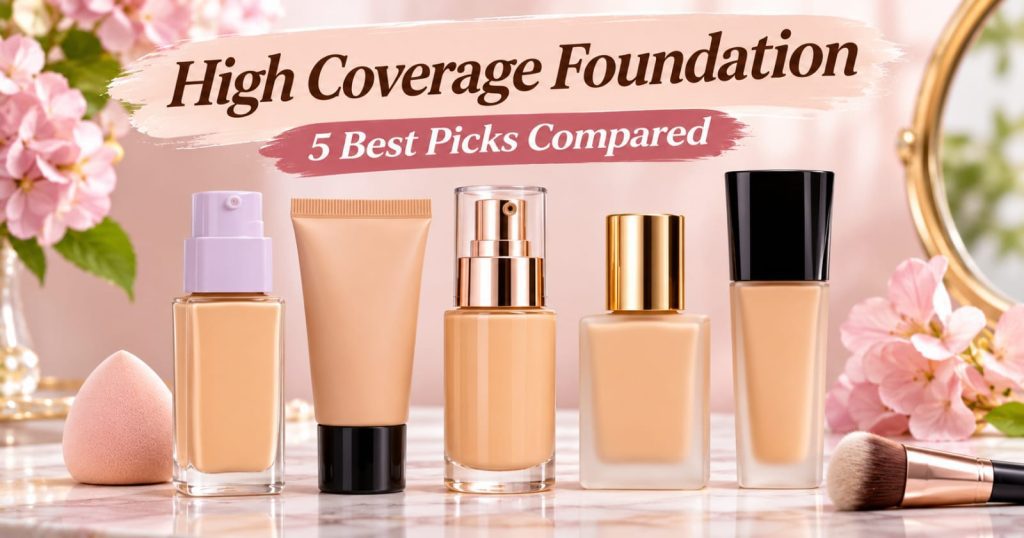
If you’ve ever tried to cover acne marks, redness, or dark spots with a sheer base, you know how frustrating it can be. You blend and blend, and the problem areas keep peeking through. That’s exactly when a high coverage foundation earns its place in your makeup bag.
The trick is finding one that actually hides what you want to hide without looking heavy, flat, or cakey. Some formulas do a great job on day one and then crease by lunchtime. Others feel comfortable but give you less coverage than the label promises.
This guide compares five high coverage options at different price points, explains what coverage really means, and shows you how to choose a shade, prep your skin, and make your makeup last.
5 Best High Coverage Foundations at a Glance
Here’s a quick comparison. The prices below are the listed prices I found on brand or major retailer pages while researching. They change often, so check the current price before you buy.
| Product | Coverage | Finish | Listed price | Shades listed |
| Maybelline Super Stay Lumi-Matte | Buildable full | Semi-matte with a hint of glow | $11.99 | 24 |
| Revlon ColorStay Full Cover | Full, buildable | Matte | $16.99 | 16 |
| Tarte Face Tape Foundation | Full, buildable | Natural matte | $35 | About 50 |
| Estée Lauder Double Wear Stay-in-Place | Medium to full, buildable | Matte | $52 | Over 55 |
| Lancôme Teint Idôle Ultra Wear | Full, buildable | Natural matte | $53 | Over 50 |
One honest note before we go further. I’m sharing what the brands and retailers publish, along with how formulas generally behave. I haven’t tested these myself, so your results can differ depending on your skin type, prep, and shade.
How I Chose These Foundations
I didn’t want five products that were basically the same. So I looked for a mix of price tiers, finishes, and formula styles, and I only included products with published coverage claims that I could verify.
Each pick needed to meet most of these points:
- A clear full or buildable-to-full coverage claim
- Published information on finish and wear time
- A realistic price range for everyday shoppers
- A broad enough shade range to be worth considering
- Availability from major US retailers, including Amazon
I also paid attention to drawbacks. Every foundation has trade-offs, and I’d rather tell you who might not like a product than pretend one formula works for everyone.
The 5 Best High Coverage Foundations Reviewed
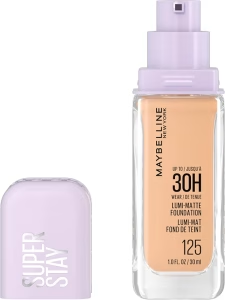
- Maybelline Super Stay Lumi-Matte: Best Drugstore Pick
This is the most affordable option on the list at $11.99 for one fluid ounce. The listing describes it as a buildable full coverage foundation with a semi-matte finish and a hint of luminosity, which makes it a good middle ground if you don’t love a completely flat look.
It’s marketed as up to 30-hour wear and resistant to sweat, water, and transfer. The ingredient list includes niacinamide, and the brand lists it as vegan, non-comedogenic, and dermatologist tested. It comes in 24 shades.
**Who may like it:**
- Shoppers on a budget
- People who want full coverage with a slightly softer, less flat finish
- Anyone who wants an easy-to-find drugstore formula
**Things to consider:**
- The shade range is smaller than the premium options
- Any foundation with long-wear claims can feel heavy if applied thickly
- No SPF was listed on the page I checked
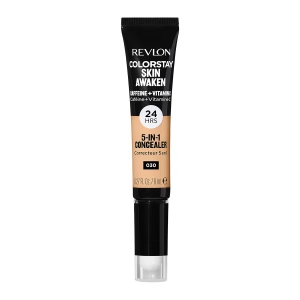
- Revlon ColorStay Full Cover: Best for a Matte Look
Revlon’s ColorStay Full Cover is a lightweight liquid in a squeezable tube. The brand describes it as full, buildable coverage with a matte finish, and says it’s heat and sweat resistant with up to 24 hours of wear. It’s listed at $16.99.
It’s a good pick if you want strong coverage over blemishes or uneven tone and prefer a matte finish. Reviewers on the brand’s page praise the coverage and the lightweight feel, though one mentions a greasier finish after a formula change and another noticed oxidation.
**Who may like it:**
- People who like matte makeup
- Shoppers looking for strong coverage under $20
- Those who prefer a squeeze-tube format
**Things to consider:**
- It has only 16 shades, so finding a perfect match may take some patience
- Reviewers mention oxidation, so test your shade and wait a few minutes before judging it
- Ingredients, size, and skin-type details weren’t listed on the page I checked
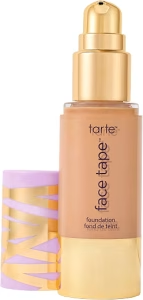
- Tarte Face Tape Foundation: Best for Normal and Oily Skin
Tarte’s Face Tape Foundation is built around a “full coverage without the full feel” idea. It offers buildable full coverage with a natural matte finish, and the brand claims 12-hour wear that’s transfer-proof, waterproof, and sweatproof. The standard size is 1.01 fl oz and listed at $35.
The brand says the formula includes snow mushroom extract and hyaluronic acid for hydration. The page recommends it for normal and oily skin and suggests a hydrating primer if your skin is very dry.
**Who may like it:**
- People with normal, combination, or oily skin
- Anyone who wants strong coverage with a more natural-looking finish
- Shoppers looking for a large shade range of around 50
**Things to consider:**
- It’s a mid-priced option
- A setting powder is optional, but the brand says it can help with creasing
- Dry skin may need extra prep to avoid a patchy look
- Some shades showed as sold out on the page I checked, so confirm availability
- Estée Lauder Double Wear Stay-in-Place: Best Long-Wear Classic
Double Wear is one of the best-known long-wear foundations in the US. The brand describes it as medium-to-full, buildable coverage with a matte, waterproof finish, and it claims 24-hour wear without settling into fine lines or pores. It costs $52 for one ounce.
It’s listed as oil-free, water-based, non-comedogenic, dermatologist-tested, and free of synthetic fragrance. The shade range is over 55 shades, which is one of the largest here.
**Who may like it:**
- People who need a foundation to last through a long day or event
- Those with oily or combination skin who want oil control
- Anyone who wants an extensive shade range
**Things to consider:**
- It’s one of the pricier picks
- It’s technically medium-to-full, so you’ll need to build it up for full coverage
- A matte finish may look dry on very dry skin without good prep
- No SPF was listed on the page I checked
- Lancôme Teint Idôle Ultra Wear: Best Splurge
Lancôme’s Teint Idôle Ultra Wear is the most premium formula here, with a listed price of $53 for one ounce at Ulta. It offers full, buildable coverage with a natural matte finish and is marketed as 24-hour wear that resists water, sweat, and humidity.
The brand says it includes hyaluronic acid, vitamin E, and prebiotics, and describes it as fragrance-free and made without mineral oils. It comes in over 50 shades, and the brand says it’s made for all skin types, including mature and sensitive.
**Who may like it:**
- People who want a luxury formula with a wide shade range
- Those who want full coverage that still feels breathable
- Shoppers who like skincare-style ingredients in their makeup
**Things to consider:**
- It’s the most expensive option on the list
- No SPF was listed on the page I checked
- The brand’s skin benefit claims come from its own consumer testing, so treat them as marketing, not guarantees
What Does High Coverage Foundation Really Mean?
A high coverage foundation contains more pigment than a sheer or medium option, so it hides more of what’s underneath. That can include redness, acne marks, dark spots, or uneven tone.
Most formulas are buildable. That means one thin layer gives you medium coverage, and a second layer in problem areas gives you more. This is useful because you rarely need full coverage everywhere on your face.
Coverage and finish are two different things, and people often confuse them. Here’s how they compare.
| Coverage | Finish | |
| What it describes | How much it hides | How it looks and feels on skin |
| Examples | Sheer, medium, full | Matte, natural, radiant, dewy |
| Can they mix? | Yes | Yes |
For example, you can find a full coverage foundation with a glowy finish, and a matte foundation with only medium coverage. Don’t assume high coverage always means flat and matte.
How to Choose the Best High Coverage Foundation
Picking the right one comes down to a few simple questions.
Start With Your Skin Type
Dry skin usually looks better with creamy, hydrating formulas, while oily skin often prefers matte, oil-controlling ones. Combination skin can go either way, depending on which area bothers you most.
Think About the Finish
If you like a skin-like look, choose a natural or semi-matte option. If you want maximum oil control, a matte formula may suit you better.
Match the Formula to Your Routine
If you’re in a hurry, a liquid in a tube or bottle is easy to apply. If you like to build coverage slowly, a buildable liquid gives you control.
Consider Your Budget
Price doesn’t tell you how well a foundation will work for you. A $12 formula can outperform a $50 one on your skin, and the reverse is also true. Choose based on coverage, finish, shade range, and how it behaves on your skin.
High Coverage Foundation by Skin Type
Oily Skin
Look for matte or natural-matte formulas with long-wear claims. Estée Lauder, Revlon, and Tarte all fit that description on paper. Setting your makeup lightly with powder can help control shine.
Dry Skin
Choose a foundation with a more natural or radiant finish, and prep with a moisturizer. Very matte, full-coverage formulas can emphasize dryness, so build up thin layers instead of applying one thick layer.
Combination Skin
You may find a natural matte formula, like Tarte or Lancôme, works well. Apply the most coverage where you need it and keep other areas light.
Mature Skin
Heavy layers can settle into lines. A thin application with a damp sponge, concentrated only on areas that need it, usually looks smoother.
Sensitive or Acne-Prone Skin
Look for non-comedogenic claims and fragrance information, and read the ingredient list. Several products here make those claims, but no label can promise a reaction-free result. Test a new foundation on a small area first.
How to Find Your Shade and Undertone
A mismatched shade is more noticeable with full coverage, because there’s more pigment sitting on your skin. A small shade mistake can look like a mask.
Skin tone is how light or deep you are. Undertone is the warm, cool, neutral, or olive hue beneath the surface. You’ll want to consider both.
Here are some tips to get it right:
- Swatch two or three shades along your jawline, not your wrist
- Check them in natural daylight
- Wait several minutes, since some formulas oxidize and darken
- Blend the swatch into your neck, since the color shouldn’t stop at your jaw
- When shopping online, read reviews from people with a similar undertone, and check the return policy
Different brands name their shades differently, so don’t assume your shade in one line will match another.
How to Apply High Coverage Foundation Without a Cakey Finish
Cakiness usually comes from too much product or poor prep, not from the foundation alone.
Prep Your Skin
Cleanse and moisturize, and let your skincare settle for a few minutes. If you use primer, pick one that suits your skin type.
Choose the Right Tool
A damp sponge tends to give a more skin-like look, while a dense brush can give a smoother, more polished finish. Either works if you use thin layers.
Build in Thin Layers
Start with a small amount in the center of your face and blend outward. Add a second thin layer only where you need more coverage, such as around the nose or over dark spots.
Spot Conceal Instead of Piling On
If one area needs extra coverage, use a small amount of concealer on top of the foundation instead of adding more foundation all over.
Set Strategically
Use a light dusting of translucent powder where you tend to get shiny or where creasing happens. A setting spray can help melt the layers together.
How to Make Your Foundation Last Longer
Long-wear claims are helpful, but your prep and technique still matter.
- **Start with a good base:** Moisturized skin helps makeup grip better.
- **Use thin layers:** Thick layers tend to crease and slide.
- **Set with powder:** Focus on your T-zone and under the eyes.
- **Add a setting spray:** It can help lock everything in.
- **Blot, don’t rub:** If you get shiny, press gently with a tissue or blotting paper.
Keep in mind that “long-wear,” “waterproof,” “sweatproof,” and “transfer-proof” aren’t the same thing. A foundation can be water resistant and still smudge when you rub your face.
Also, if your foundation includes SPF, remember that makeup alone often isn’t enough protection. Apply sunscreen first, then your foundation.
Common Mistakes to Avoid
A few habits cause most complaints about heavy-looking makeup.
- **Using too much at once.** One thick layer looks heavier than two thin ones.
- **Skipping moisturizer.** Dry patches grab pigment and look rough.
- **Picking a shade that’s too light.** It can look gray or mask-like, especially in photos.
- **Over-powdering.** Too much powder can make texture more obvious by the afternoon.
- **Forgetting your neck.** Blend down so there’s no visible line at the jaw.
Fixing even one or two of these usually makes a noticeable difference.
Drugstore vs. Premium: Is It Worth Paying More?
Sometimes, but not always. On this list, Maybelline and Revlon cost under $20, while Estée Lauder and Lancôme cost over $50.
A higher price may get you a larger shade range, a more refined texture, or skincare-style ingredients. It doesn’t guarantee better coverage or better wear on your skin. If a drugstore
formula works for you, there’s no need to spend more.
Frequently Asked Questions
What is the best high coverage foundation?
There isn’t one winner for everyone. Maybelline is a great budget pick, Revlon is a strong matte option, Tarte suits normal to oily skin, Estée Lauder is a long-wear classic, and Lancôme is a premium choice.
What’s the difference between high coverage and full coverage foundation? The terms are often used interchangeably. Full coverage usually means the strongest level of coverage, while high coverage can include medium-to-full formulas you build up.
Which foundation is best for oily skin?
Matte or natural-matte formulas, such as Estée Lauder Double Wear or Revlon ColorStay, are good places to start.
Which foundation is best for dry skin?
Look for a hydrating formula with a natural finish, and prep your skin well. Apply in thin layers.
Can full coverage makeup look natural?
Yes. Thin layers, a damp sponge, and good blending can help a full-coverage formula look more skin-like.
How do I stop full coverage foundation from looking cakey?
Prep your skin, use less product, build in thin layers, and use powder only where you need it.
Is full coverage foundation suitable for acne-prone skin?
Some formulas are labeled non-comedogenic, but each person’s skin is different. Test a small area first, and remove your makeup thoroughly at night.
How do I choose the right foundation shade?
Swatch a few shades along your jawline in natural light and wait a few minutes to see how they settle.
Final Thoughts
The best high coverage foundation is the one that fits your skin type, finish preference, shade, and budget. Maybelline and Revlon are great if you want strong coverage without spending much, while Tarte, Estée Lauder, and Lancôme offer bigger shade ranges and more polished formulas.
Prep your skin, apply thin layers, and build coverage only where you need it. Always check the current price, shade list, and ingredients before you buy.
If you want to read more about this, check out our detailed guide here:https://zaisufbeauty.com/best-skin-tightening-cream/