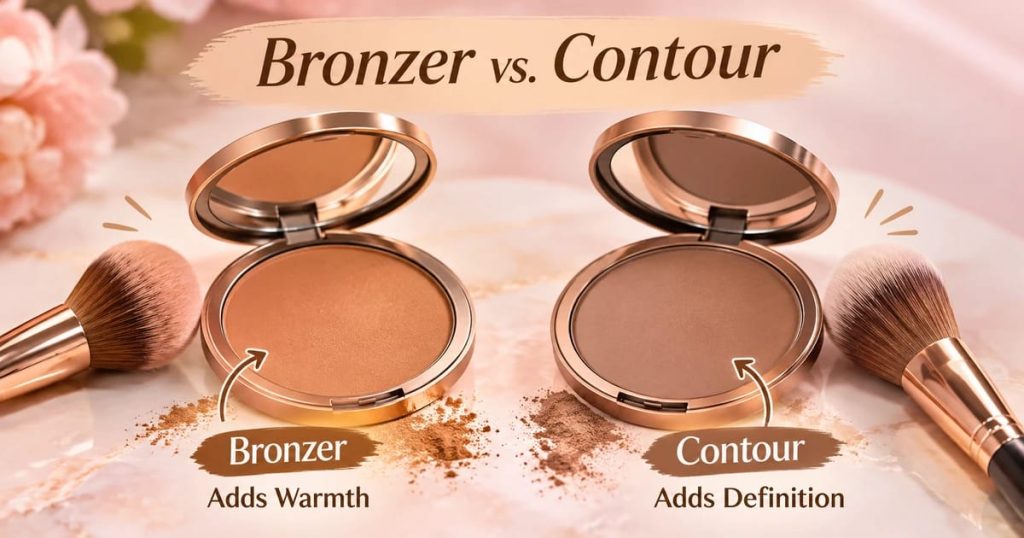
You open a makeup drawer and find two brown-ish products that look almost identical. One says bronzer, the other says contour, and you’re not sure which one to reach for. If you’re wondering what is the difference between bronzer and contour, you’re far from alone, because they really do look alike in the pan.
Here’s the short version. Bronzer adds warmth, like a light tan. Contour adds shadow, to make features look more defined. They sit in different places on the face, and they’re usually in different shades.
This guide explains each product, where to apply it, how to choose shades and formulas, and when you can use both. You’ll also find fixes for common mistakes.
What Is the Difference Between Bronzer and Contour? The Quick Answer
Both products are used to add color and dimension, but their jobs are different. Bronzer warms your skin and mimics a sun-kissed glow. Contour imitates natural shadows so your features look more sculpted.
Here’s a side-by-side look:
| Bronzer | Contour | |
| Main purpose | Adds warmth and a healthy glow | Creates the look of shadow and definition |
| Undertone | Warm (golden, bronze, caramel) | Neutral to cool (taupe, soft brown) |
| Shade depth | Close to a natural tan | Usually a bit deeper than your skin |
| Finish | Matte, satin, or shimmery | Usually matte |
| Typical placement | Where the sun hits | In natural hollows and recesses |
| Visual result | A warm, lit-from-within look | A softer, more defined structure |
Neither product physically changes your face. Both just play with color and light to create the illusion of warmth or shadow.
What Does Bronzer Do?
Bronzer adds warmth. It gives your skin the look of a day in the sun, and it can make a pale or dull complexion look healthier.
Where Bronzer Is Typically Applied
Bronzer follows the places the sun naturally touches: the tops of the cheekbones, the temples, along the hairline, and a light touch across the bridge of the nose. Many people also blend a little onto the jawline and neck so everything looks even.
Bronzer Finishes
Bronzers come in matte, satin, and shimmery finishes. Matte looks most like real skin, satin adds a soft sheen, and shimmery options add sparkle. For a natural look, matte or satin is usually the safest choice.
What Does Contour Do?
Contour creates shadow. By placing a slightly deeper, cooler shade in the recesses of your face, you can make cheekbones, the jaw, or the sides of the nose look more defined.
Where Contour Is Typically Applied
Contour goes where shadows would naturally fall: just under the cheekbones, along the jawline, at the sides of the nose, and near the hairline. The key is to keep it close to your natural bone structure so it looks like a shadow, not a stripe.
Contour Finishes
Most contours are matte, since shadows don’t sparkle. A matte, skin-like finish helps the effect look natural. Shimmer in a contour shade can reflect light and defeat the purpose.
Bronzer vs. Contour: 6 Key Differences
Let’s break down the differences one at a time.
- Purpose
Bronzer adds warmth and color. Contour adds definition and depth. One makes your skin look sun-touched, and the other makes your features look sculpted.
- Shade and Undertone
Bronzer is warm-toned, so it leans golden or reddish. Contour leans neutral to cool, which helps it look like a shadow instead of a tan.
- Finish
Bronzer can be matte, satin, or shimmery. Contour is typically matte.
- Placement
Bronzer goes on the high points the sun hits, while contour goes in the hollows. The two overlap in a few areas, like the temples and jawline, but they’re used differently.
- Visual Result
Bronzer gives a warm, healthy glow. Contour gives a more defined structure. When you use both, you get warmth with shape.
- Formula Options
Both come in powder, cream, liquid, and stick forms. The formulas look similar, but the shade and finish usually differ.
Where to Apply Bronzer and Contour
Placement shows what is the difference between bronzer and contour more clearly than anything else. Here’s a simple map.
**Bronzer:** Tops of the cheekbones, temples, hairline, nose bridge, and jawline blended into the neck.
**Contour:** The hollow beneath the cheekbones, along the jaw, the sides of the nose, and near the hairline.
Both products are optional in every area. You don’t need to use every placement, and many people skip the nose or jaw.
Face-Shape Ideas
Face shapes can guide your placement, but they’re suggestions, not rules.
- **Round:** Blend a little more warmth or shadow along the outer edges of the face
- **Oval:** The standard placements work well
- **Square:** Soften corners by blending in rounded strokes
- **Heart-shaped:** Add balance at the temples and a light touch near the jaw
Blending Tips That Make Both Look Natural
Blending does more work than the product itself. A few habits help:
- Start with a small amount, then build slowly. It’s much easier to add than to remove.
- Use a fluffy brush for powder and a damp sponge or dense brush for cream and liquid formulas.
- Use light, circular or windshield-wiper motions, and keep blending until you can’t see where the product starts.
- Check your face in natural light from a window. Bathroom lighting often hides harsh edges.
- Step back from the mirror. If you can spot a stripe from arm’s length, keep blending.
A soft edge is what separates a shadow from a streak, and it’s the same rule for both products.
Which Should You Choose?
Here’s a quick guide based on what you want.
| Your goal | Good starting choice |
| A warm, healthy-looking complexion | Bronzer |
| More defined cheekbones | Contour |
| Natural everyday makeup | A light bronzer; contour is optional |
| A sculpted makeup look | Contour, with bronzer if you like |
| A minimal routine | Just the one that gives you the result you want |
If you’re just starting out, bronzer is usually more forgiving. It adds color without needing precise blending. Once you’re comfortable, you can add contour for more definition.
You don’t have to buy both. If you’re asking what is the difference between bronzer and contour because you’re deciding what to buy, start with the one that matches your goal and add the other later.
Real-Life Examples
Say you’re heading out for a quick coffee. A touch of bronzer on the cheeks and temples is plenty, and it takes under a minute. Now say you’re dressing up for a photo shoot or an event with bright lighting. A matte contour under the cheekbones adds the depth that cameras and flash can flatten out, and a little bronzer over it keeps the face from looking pale.
Neither routine is better. They simply fit different moments, which is why many makeup bags hold both.
How to Choose the Right Shade for Your Skin Tone
Shade is the most important part of getting either product right. A shade that’s wrong for your skin can look orange, gray, or muddy, even if the placement is perfect.
Skin Tone vs. Undertone
Skin tone is how light or deep your skin is. Undertone is the warm, cool, or neutral hue beneath it. They’re two different things, and you’ll need to consider both.
Choosing a Bronzer Shade
Pick a bronzer that looks like a natural tan on you, usually about one to two shades deeper than your skin. Match the warmth to your undertone, and avoid anything that looks too orange or too red.
Choosing a Contour Shade
Pick a matte shade that looks like a shadow. It’s usually one to two shades deeper than your skin, with a neutral or cool undertone. If it looks orange, it’s too warm. If it looks gray, it’s too cool or too dark.
By Skin Tone
- **Fair skin:** Choose soft, light bronzers and a gentle taupe contour
- **Light to medium skin:** Warm golden bronzers and a soft neutral brown contour work well
- **Olive skin:** Look for bronzers with a golden or slightly green-neutral balance, and an earthy contour
- **Tan skin:** Richer caramel bronzers and a deeper, neutral contour are good starting points
- **Brown and deep skin:** Choose deeper golden, copper, or reddish-brown bronzers, and a rich contour with enough pigment so it doesn’t look ashy
Brown skin isn’t one undertone or one shade, so test before you commit. Swatch on your jawline or cheek and check in natural light. When it comes to what is the difference between bronzer and contour, shade is where most people go wrong.
Cream vs. Powder vs. Liquid vs. Stick
Both products come in several formulas. The formula doesn’t change what is the difference between bronzer and contour, but it does change how each one looks and wears.
| Formula | Potential advantage | Consider |
| Cream | Skin-like finish, blends easily | Needs a compatible base |
| Powder | Buildable and easy to diffuse | Can emphasize dry patches |
| Liquid | Sheer, buildable color | Needs careful blending |
| Stick | Convenient and precise | Swiping can disturb your base |
Don’t assume every oily skin needs powder or every dry skin needs cream. Try what feels comfortable and wears well for you.
How to Use Bronzer and Contour Together
Once you understand what is the difference between bronzer and contour, using both is simple. Here’s a routine.
Step 1: Finish Your Base
Apply foundation and concealer first. If you’ll use cream products, do them before any setting powder.
Step 2: Apply Contour First
Place contour in the hollows under your cheekbones and along any other areas you like. Blend well so it looks like a soft shadow.
Step 3: Add Bronzer on Top
Sweep bronzer over the high points where the sun hits. Blend where it meets the contour so there’s no line.
Step 4: Finish With Blush and Highlighter
Add blush and highlighter if you like. These are optional.
Cream and Powder Order
Cream products go on before powder. If you mix formulas, apply cream contour and cream bronzer first, then use powder on top. Don’t layer cream over powder, since it can look patchy.
Can You Use Bronzer as Contour?
Sometimes. Using bronzer in place of contour is a popular shortcut, often called “brontouring.” It gives a softer, warmer version of definition, and it works well for natural looks.
It works best when your bronzer is matte and only a shade or two deeper than your skin. If your bronzer is very orange or shimmery, it won’t look like a shadow, and it may look warm instead of sculpted.
If you want a sharper, cooler definition, a true contour shade will do a better job.
Bronzer vs. Contour vs. Blush vs. Highlighter
What is the difference between bronzer and contour compared with blush and highlighter? Here’s a four-product look.
| Product | Main purpose | Typical placement |
| Bronzer | Warmth | Sun-exposed areas |
| Contour | Shadow and definition | Natural recesses |
| Blush | Color on the cheeks | Apples of the cheeks |
| Highlighter | Light-reflecting glow | Selected high points |
Concealer is different from all four. Its main job is covering and brightening, not shaping the face, so it isn’t a replacement for contour.
What Can I Use Instead of Bronzer or Contour?
If you don’t have one of them, you can improvise.
- **Contour substitute:** A matte, neutral or cool-toned shade that looks like a shadow, such as a deeper concealer or a matte powder made for the face
- **Bronzer substitute:** A warm-toned face product, as long as the formula suits your base and is meant for the skin
- **Skip both:** You can leave them out entirely for a minimal routine
Not every substitute suits every skin tone or formula, so test first. Use only products meant for the face.
Bronzer and contour are also sold as sticks and as palettes. A stick is quick and easy to blend, and a palette gives you both shades together, which is handy if you want to use them as a pair.
Does Bronzer Replace Sunscreen?
No. Bronzer and contour are cosmetic products, and neither one protects your skin from the sun. A bronzed look from makeup only changes how your skin appears. If you spend time outdoors, sunscreen is still a separate step, and the American Academy of Dermatology notes that makeup with SPF alone usually isn’t enough coverage. Apply sunscreen first, let it settle, and then do your makeup as usual.
Common Mistakes and How to Fix Them
Most mistakes come from mixing up what is the difference between bronzer and contour. Here’s how to fix the most common ones. Rushing the blend and picking a shade that’s too warm or too deep are the two biggest culprits, so slow down and test your shade first.
| Problem | Likely reason | Fix |
| Orange contour | Shade is too warm | Choose a more neutral or cool shade |
| Gray or muddy face | Wrong undertone or too much product | Reassess the shade and use thin layers |
| Harsh lines on the cheeks | Poor blending or too much product | Use less and blend gradually |
| Patchy bronzer | Uneven base or incompatible layers | Check your base and formula |
| Contour looks too dark | Shade is too deep | Use a lighter, buildable shade |
| Face looks too warm | Too much bronzer | Reduce the amount and placement |
Frequently Asked Questions
What Is the Difference Between Bronzer and Contour in Simple Terms? Bronzer adds warmth, like a tan. Contour adds shadow, to define your features. Bronzer is warm-toned and goes where the sun hits, and contour is cooler and goes in hollows.
Which is better, contour or bronzer?
Neither is better, because they do different jobs. Bronzer is great for a natural, warm look, and contour is better for definition. Choose based on your goal.
Can I use bronzer as contour?
Yes, if your bronzer is matte and not too orange. It gives a softer effect than a true contour.
Do I need both bronzer and contour?
No. Many people use only one. You can start with bronzer, then add contour later if you want more definition.
Which is darker, contour or bronzer?
It depends on the product. Contour is often a bit deeper and cooler, while bronzer is warmer. Both should be close to your skin depth so they look natural.
Is bronzer or contour better for a natural look?
A light bronzer is usually the easier choice for a natural, everyday look.
Is bronzer or contour better for beginners?
Bronzer is generally more forgiving, since it doesn’t need precise placement.
Which should go first, bronzer or contour?
Contour goes first, then bronzer, with cream products before powder.
Final Thoughts
Now you know what is the difference between bronzer and contour: one adds warmth and the other adds shadow. They look similar in the pan, but they work in different places and in different shades.
If you remember only one thing about what is the difference between bronzer and contour, remember this: warmth versus shadow. Everything else, from placement to shade, follows from that single idea. Many people also find that their needs change with the season, the occasion, or even their mood, so it’s fine to reach for bronzer one day and contour the next.
Start with the product that matches your goal, choose a shade that suits your skin tone and undertone, and blend well. You don’t need both to look great, and a soft, natural result is almost always more flattering than a heavy one.
If you want to read more about this, check out our detailed guide here:https://zaisufbeauty.com/how-long-to-leave-coconut-oil-in-hair/