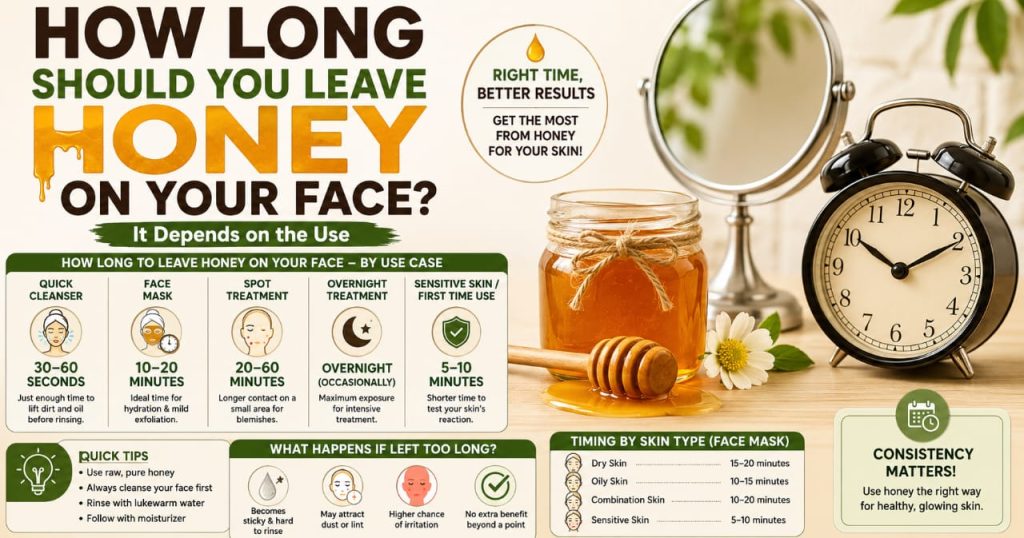
Search for how long should you leave honey on your face and you’ll find genuinely conflicting answers, anywhere from 8 minutes to overnight, depending on which site you land on. The reason for the inconsistency isn’t that anyone’s wrong, it’s that the right answer depends entirely on how you’re using honey. A quick
cleanse, a standard mask, a targeted spot treatment, and an overnight treatment all call for different timing.
This guide breaks down the recommended duration for each specific use case, why the timing differs, and what actually happens if you leave it on too long. For the full application process, see how to apply honey on face, and for daily-use frequency guidance, see can I apply honey on my face every day.
Many people search for how long should you leave honey on your face because different websites recommend different timings. The best duration depends on whether you are using honey as a cleanser, face mask, or spot treatment.
Table of Contents
- Quick Answer
- Timing Chart by Use Case
- Why the Recommended Time Varies
- Quick Cleanser: 30-60 Seconds
- Daily Face Mask: 1 0-20 Minutes
- Spot Treatment: 20-60 Minutes
- Can You Leave Honey on Your Face Overnight?
- Timing by Skin Type
- What Happens If You Leave Honey On Too Long
- . Frequently Asked Questions
- Final Thoughts
Quick Answer
How long you should leave honey on your face depends on how you’re using it: 30 to 60 seconds if you’re using it as a quick cleanser, 1 0 to 20 minutes for a standard face mask, 20 to 60 minutes for a targeted spot treatment on a blemish, and overnight only occasionally, for a more intensive treatment. There’s no single universal answer, since each use case is asking honey to do something different.
If you are wondering how long should you leave honey on your face, starting with 10 to 15 minutes is a safe option for most skin types before trying longer applications.
Timing Chart by Use Case
Use Case | RecommendedTime | Why |
Quick cleanser | 30-60 seconds | Just enough contact time to lift dirt and oil before rinsing |
| Standard facemask | 1 0-20 minutes | Enough time for hydration and mild exfoliation without excess stickiness |
| Spot treatmenton a blemish | 20-60 minutes | Longer, concentrated contact on a small area, rather than the whole face |
Overnight | Occasional use only | Maximum exposure time, but not necessary or ideal for regular use |
| Sensitive skin, first-time use | 5-1 0 minutes | Shorter window to gauge your skin’s reaction before extending time |
Why the Recommended Time Varies
The honest answer is that there isn’t strong clinical research pinning down an exact “optimal” number of minutes for honey on skin. The ranges you see across different sources are largely based on practical experience and reasonable logic rather than rigorous studies: enough time for honey’s humectant and mild
antibacterial properties to have some contact with the skin, without leaving it on so long that it becomes uncomfortably sticky or impractical.
This is exactly why the recommended time shifts based on what you’re trying to accomplish. A quick cleanse just needs enough time to loosen dirt and oil before rinsing. A mask benefits from a longer sit to allow more hydration. A spot treatment on a single blemish can reasonably stay on longer, since you’re not
leaving a sticky layer across your entire face.
Understanding how long should you leave honey on your face helps you avoid leaving it on longer than necessary, which usually adds more stickiness than skincare benefits
Quick Cleanser: 30-60 Seconds
Using honey as a cleanser is a short-contact use case. Wet your face, massage a small amount of honey in circular motions for about 30 to 60 seconds, then rinse thoroughly. This is enough time for honey’s gentle cleansing properties to help lift away dirt and light makeup residue without needing to treat it like a mask.
Before trying overnight treatments, ask yourself how long should you leave honey on your face based on your skin type and your skincare goals rather than copying someone else’s routine.
Daily Face Mask: 1 0-20 Minutes
This is the most common way people use honey, and 1 0 to 20 minutes is the range most consistently recommended across sources. It’s enough time for the skin to benefit from honey’s moisture-retaining properties without the mask
drying out or becoming excessively tacky. For most people, starting at 1 5 minutes is a reasonable middle ground.
The question how long should you leave honey on your face is especially important for people with sensitive skin because shorter application times are often more comfortable.
Spot Treatment: 20-60 Minutes
When honey is used specifically on a blemish rather than the whole face, longer contact time is more commonly recommended, generally in the 20 to 60 minute range. Since you’re only treating a small area rather than your entire face, the extended time is more practical and less likely to cause the widespread stickiness that a full-face application would over the same duration.
When researching how long should you leave honey on your face, you will notice that most experts recommend different timings for cleansing, masking, and treating individual blemishes.
Can You Leave Honey on Your Face Overnight?
Yes, you can leave honey on your face overnight, and it gives honey the longest possible contact time with
your skin. Some sources suggest this can be worth it occasionally, particularly for a more intensive hydration boost or for a specific concern like an active blemish. That said, it’s worth treating overnight use as an occasional option rather than a nightly routine, for a few practical reasons:
- It can stain or stick to your pillowcase, so using an old or dedicated pillowcase is worth considering if you go this route
- Extended exposure increases the chance of irritation for anyone whose skin is on the more reactive side, even if honey itself is generally gentle
- There’s no strong evidence that overnight use provides dramatically better results than a standard 1 5-20 minute mask used consistently over time
If you want to try it, doing so once every week or two, rather than nightly, is a reasonable, cautious approach.
How to Apply Honey on Your Face Overnight
If you decide to try an overnight treatment, applying it correctly makes it more comfortable and easier to clean up:
- Patch test first, especially if this is your first time trying an overnight application. Apply a small amount to your inner arm and wait 24 hours to check for a reaction.
- Cleanse your face as you normally would before bed, so honey makes contact with clean skin rather than sitting over makeup, dirt, or oil.
- Apply a thin layer of raw honey to your face using clean fingertips. A thin layer is enough — a thick layer just means more stickiness overnight without added benefit.
- Use an old or dedicated pillowcase, since honey can transfer and stain fabric.
- Leave it on overnight and rinse thoroughly with lukewarm water in the morning.
- Moisturize as usual after rinsing to lock in hydration.
How to Use Honey on Your Face Overnight Safely
To use honey on your face overnight without unnecessary irritation, keep a few precautions in mind: avoid it if you have a known honey or bee product allergy, skip it on nights when your skin already feels sensitive or reactive, and don’t make it a nightly habit — treat it as an occasional, once-a-week-or-two treatment rather than a permanent part of your
routine. If your skin feels tight, itchy, or irritated in the morning, that’s a sign to shorten the duration or skip overnight use going forward.
Timing by Skin Type
Sensitive skin should start with a shorter window, around 5 to 1 0 minutes, to gauge how skin reacts before extending the time on future applications.
Dry skin can generally tolerate the full 1 5-20 minute range comfortably, and may benefit from the longer end of that window for extra hydration.
Oily skin tends to do well with the standard 1 0-1 5 minute range; leaving it on much longer doesn’t necessarily provide extra oil-balancing benefit.
Combination skin can generally follow the standard 1 0-20 minute guidance without needing to treat different zones differently for this particular step.
If your skin feels irritated after using honey, reconsider how long should you leave honey on your face and reduce the application time during your next session.
What Happens If You Leave Honey On Too Long
Leaving honey on well beyond the recommended time for your use case isn’t typically dangerous, but it does carry a few realistic downsides:
Increasingly sticky, tacky residue that becomes harder to rinse off cleanly
Honey can attract dust or lint to your skin the longer it sits exposed, particularly if you’re moving around rather than resting
Slightly increased chance of irritation, particularly for reactive or sensitive skin left in prolonged contact
No meaningful extra benefit beyond a certain point; hydration and mild exfoliation don’t scale indefinitely with time
If you accidentally leave it on much longer than planned, simply rinse thoroughly with lukewarm water and follow with your regular moisturizer. It’s not typically a cause for concern, just a slightly stickier cleanup.
People often ask how long should you leave honey on your face because they want the best results without causing irritation or making the skin feel overly sticky.
Frequently Asked Questions
How long should you leave honey on your face?
It depends on the use case: 30-60 seconds for a quick cleanse, 1 0-20 minutes for a standard mask, 20-60 minutes for a spot treatment, and overnight only
occasionally.
Can I leave honey on my face overnight?
Yes, occasionally, though it’s better treated as an occasional intensive treatment than a nightly habit, and using an old pillowcase is worth considering.
Is 1 0 minutes enough for a honey face mask?
Yes, 1 0 minutes is on the shorter end of the standard range and is a reasonable starting point, especially for sensitive skin or first-time use.
Can I leave honey on for 30 minutes?
Yes, this falls within the reasonable range for a spot treatment or a longer mask session, particularly for non-sensitive skin.
What happens if I leave honey on too long?
It typically just becomes stickier and harder to rinse, with a slightly increased chance of irritation, rather than causing any serious harm.
Should I wash my face before applying honey?
Yes, always cleanse first so honey makes direct contact with clean skin rather than sitting over dirt, oil, or makeup residue.
Should I moisturize after using honey?
Yes, following with your regular moisturizer helps lock in the hydration honey provides, regardless of how long you left it on.
How long should honey stay on for acne?
As a spot treatment on an active blemish, 20 to 60 minutes is a commonly recommended range, applied directly to the affected area rather than the whole face.
For more evidence-based skincare information, you can also visit the American Academy of Dermatology (AAD) and MedlinePlus. These trusted medical resources provide guidance on healthy skincare routines, skin conditions, and the safe use of natural ingredients.
Final Thoughts
There’s no single correct answer to how long you should leave honey on your face, because the right timing depends on whether you’re cleansing, masking, spot-treating, or doing an occasional overnight treatment. Thirty to sixty seconds for a quick cleanse, 1 0 to 20 minutes for a standard mask, and 20 to 60 minutes
for a targeted spot treatment covers most situations, with overnight use reserved for occasional, more intensive sessions.
For the complete application process, see our guide on how to apply honey on face, and for guidance on how often to use it, check out can I apply honey on my face every day.
This guide answers how long should you leave honey on your face with practical recommendations for different skincare routines, helping you choose the right timing for your needs.
Disclaimer: This article is for general informational purposes. Individual skin reactions vary, and a patch test is recommended before trying any new ingredient or duration. If you have a known honey or bee product allergy, or a diagnosed skin condition, consult a dermatologist before use.