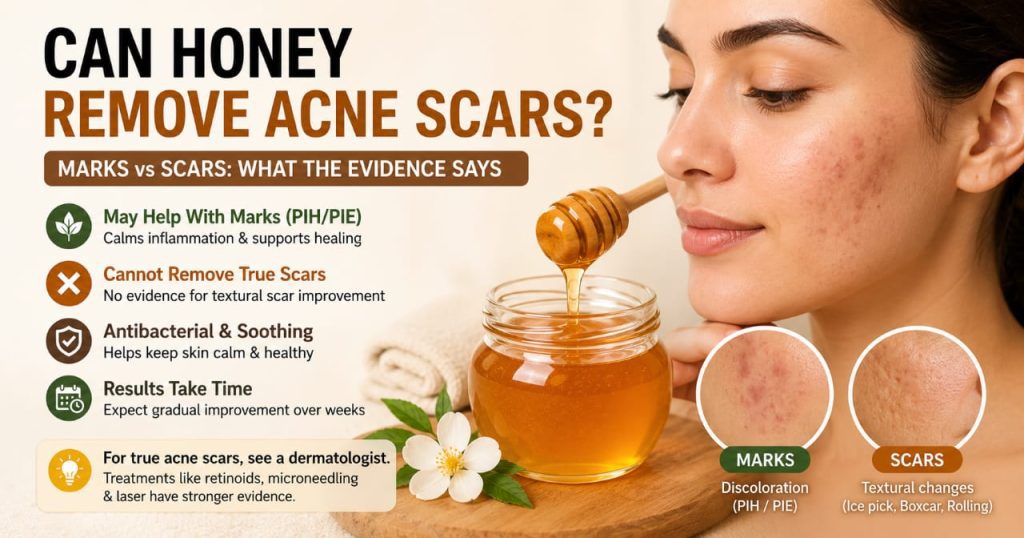
Acne scars can affect confidence long after breakouts have healed, leading many people to search can honey remove acne scars before trying expensive treatments. While honey may help soothe the skin and support the healing of post-acne marks, current scientific evidence does not show that it can remove true acne scars or repair damaged skin tissue.
No, honey cannot remove true acne scars, the kind that change the texture of your skin, like ice pick, boxcar, or rolling scars. What honey may help with is something different: the flat, discolored marks that acne leaves behind while it heals, known as post-inflammatory hyperpigmentation (PIH) and post-inflammatory erythema (PIE). Confusing these two things is the biggest source of misinformation online about honey and acne scars, so getting the distinction right matters more than
almost anything else in this topic.
Table of Contents
- Quick Answer
- Acne Marks vs Acne Scars: The Critical Difference
- What the Evidence Actually Shows
- Can Honey Help With Marks (PIH and PIE)?
- Why Honey Can’t Fix True Scars
- Raw vs Manuka Honey for Post-Acne Marks
- How to Use Honey for Fading Marks
- Realistic Results Timeline
- Common Mistakes and Misleading Claims
1 0. When to See a Dermatologist 1 1 . Frequently Asked Questions 1 2. Final Thoughts
People often turn to natural skincare after acne heals, and one of the most common questions is whether can honey remove acne scars has a positive answer. Current evidence suggests honey may support the healing process, but it does not remove true acne scars
Quick Answer
Honey cannot remove true acne scars, since these involve structural changes to the skin’s texture that a topical ingredient can’t rebuild. What honey may modestly help with is post-acne marks, the flat red or dark spots left behind after a pimple heals, by calming inflammation and supporting the skin’s natural healing process. Even for marks, evidence specifically supporting honey is limited, and results, if they happen, are gradual over many weeks, not fast or guaranteed.
Many people search can honey remove acne scars because natural remedies are often seen as safer alternatives. However, scientific evidence suggests that honey is better viewed as a supportive skincare ingredient than a proven scar treatment.
Acne Marks vs Acne Scars: The Critical Difference
This is the single most important thing to understand before trying any remedy, honey included.
| Type | What It Is | Can Honey Help? |
PIH (Post-Inflammatory Hyperpigmentation) | Flat brown or dark marks from excess melanin after healing | Possibly, modestly, over time |
PIE (Post-Inflammatory Erythema) | Flat red or pink marks from damagedcapillaries after healing | Possibly, modestly, via anti-inflammatory support |
Ice Pick Scars | Deep, narrow, pitted textural scars | No |
Boxcar Scars | Wider, box-like depressed scars | No |
Rolling Scars | Broad, wave-like depressions from tissue damage | No |
PIH and PIE are technically not scars at all, they’re color changes that occur as skin heals, and they generally do fade on their own over time, sometimes helped along by supportive skincare. True scars involve actual loss or distortion of skin tissue structure, which requires treatments that stimulate collagen remodeling,
like retinoids, microneedling, or laser therapy, none of which honey can replicate.
If you’re wondering can honey remove acne scars, it’s important to first identify whether you have true scars or post-acne marks. This distinction makes a significant difference when choosing the right treatment.
What the Evidence Actually Shows
Independent research and dermatology-reviewed sources are fairly consistent on this point: there is no credible scientific evidence that honey treats or reduces the severity of true acne scars. Some sources go further and note that raw honey isn’t connected to structural skin repair in any way that would meaningfully change scar texture.
This is worth stating clearly because a fair amount of content online, including some lower-authority skincare sites, describes honey in much more dramatic terms, claiming it can “remodel scarred tissue” or meaningfully “inhibit melanin production” at a level backed by clinical research. These claims outpace what the actual evidence supports. Honey’s antibacterial and anti-inflammatory properties are real and reasonably well-documented, particularly for wound healing, but that’s a different claim than saying it reverses existing scar tissue or acts as a targeted depigmenting treatment.
Dermatologists generally agree that can honey remove acne scars does not have a simple “yes” answer. Honey may help maintain healthy skin during healing, but it cannot repair the deeper structural damage responsible for pitted acne scars.
Can Honey Help With Marks (PIH and PIE)?
For marks specifically, rather than true scars, the case for honey is more plausible, though still not strongly proven:
Its anti-inflammatory properties may help calm the redness associated with PIE while skin heals
Its antibacterial properties may help reduce the bacterial load that
contributes to prolonged inflammation, which in theory could shorten the healing window
As a humectant and emollient, it supports overall skin hydration, which is generally beneficial during the healing process
None of this amounts to strong, direct clinical proof that honey fades PIH or PIE faster than skin would fade on its own. It’s better understood as a low-risk,
potentially mildly supportive addition to a routine, not a proven treatment for either marks or scars.
Before expecting dramatic results, ask yourself can honey remove acne scars based on scientific evidence or online myths. Current research supports realistic expectations and recommends professional treatments for noticeable textural scarring.
Why Honey Can’t Fix True Scars
True scars form when acne damages the deeper layers of skin severely enough that the body’s repair process doesn’t fully restore the original tissue structure,
leaving behind a pit, depression, or raised area. Fixing this requires stimulating new collagen production or physically resurfacing the skin, through options like:
Retinoids, which can improve texture gradually over months
Microneedling, which triggers a controlled healing response
Laser resurfacing, which removes damaged surface layers
Chemical peels, for more surface-level texture improvement
Dermal fillers, for select depressed scar types
Honey doesn’t interact with skin at the depth or mechanism needed to influence any of this. It’s a topical, surface-level ingredient, well-suited to hydration and mild calming, but not equipped to rebuild tissue structure.
Raw vs Manuka Honey for Post-Acne Marks
| Type | Relevance to Marks |
Raw Honey | Reasonable, low-cost option for general hydration and mild support during healing |
| ManukaHoney | Slightly stronger documented antibacterial activity; may offer marginally more support for inflamed marks specifically |
| ProcessedHoney | Not recommended; loses much of the enzyme activity relevant here during processing |
Neither type has strong evidence specifically for fading marks faster, so this is a reasonable-cost-vs-marginal-benefit decision rather than a clear-cut “one is proven better” situation. For more detail on choosing between them, see our best honey for face guide.
How to Use Honey for Fading Marks
- Cleanse your face gently.
- Apply a thin layer of raw or Manuka honey to the areas with marks, or across the full face as a mask.
- Leave it on for 1 5-20 minutes.
- Rinse thoroughly with lukewarm water.
- Follow with a moisturizer.
- Apply broad-spectrum sunscreen daily, since UV exposure can worsen the appearance of existing marks regardless of what topical treatments you’re using.
- Use two to three times a week, consistently, since any benefit is gradual rather than immediate.
For full application steps and timing guidance, see our companion guides: how to apply honey on face and how long should you leave honey on your face.
Realistic Results Timeline
Week 1 : Skin may feel calmer and more hydrated; no visible change in marks expected yet.
Weeks 2-4: Some newer, lighter marks may show mild, gradual fading, partly from the skin’s own natural healing process.
Weeks 6-8: Skin cell turnover generally takes around 28 days, so meaningful, visible fading of marks (if it happens) is more realistic in this window, with consistent use and sun protection.
True scars, at any point: No meaningful textural change should be expected from honey alone, regardless of how long it’s used.
Be skeptical of any claim promising acne scar removal in a week; skin’s biological turnover simply doesn’t work on that timeline, for honey or any other topical remedy.
Common Mistakes and Misleading Claims
Believing marketing claims that honey “remodels scar tissue” — this significantly overstates what current evidence supports
Confusing marks with true scars — this leads to disappointment when honey doesn’t fix textural, pitted scarring
Skipping sunscreen while trying to fade marks — UV exposure can darken or prolong the visibility of PIH specifically, undermining any progress
Using processed or fake honey diluted with sugar syrup — this doesn’t offer the same properties as genuine raw honey and, in some cases, may not be hygienic for use on healing skin
Expecting results within days — skin cell turnover takes weeks, not days
Stopping prescribed treatment for existing scars in favor of honey — professional treatments have meaningfully stronger evidence for true scar improvement
When to See a Dermatologist
Honey is a low-risk, potentially mildly supportive addition to a routine for fading marks, but it’s worth consulting a dermatologist rather than relying on home remedies if:
You have textural scarring (pitted, depressed, or raised areas) rather than flat discoloration
Marks haven’t faded after several months of consistent skincare and sun protection
Scarring is affecting your confidence or quality of life
You want to explore evidence-based options like retinoids, microneedling, chemical peels, or laser treatments
A dermatologist can also correctly distinguish between marks and true scars if you’re unsure which you’re dealing with, which meaningfully changes what treatment approach makes sense.
Skin experts often emphasize that successful scar treatment depends on identifying the correct type of skin damage. If you’re wondering can honey remove acne scars, remember that post-acne marks may gradually fade with time, while true scars usually require treatments such as microneedling, retinoids, or laser therapy for noticeable improvement.
Frequently Asked Questions
Can honey remove acne scars permanently?
No. There’s no credible evidence that honey removes or meaningfully improves true, textural acne scars.
Can honey fade dark acne marks?
Possibly, modestly, over several weeks, though evidence specifically proving this is limited. It’s a low-risk addition to a routine rather than a proven treatment.
Is Manuka honey better than raw honey for acne scars?
Marginally, due to slightly stronger antibacterial documentation, but neither has strong evidence specifically for scar or mark fading.
Can honey remove pitted scars?
No. Pitted scars (ice pick, boxcar, rolling) require treatments that stimulate collagen remodeling, which honey cannot do.
How long does honey take to work on acne marks?
If it helps at all, expect a gradual timeline of six to eight weeks or longer, alongside consistent sun protection, not a quick fix.
Can I leave honey on acne scars overnight?
Occasionally, though a standard 1 5-20 minute application is generally sufficient, and there’s no evidence overnight use meaningfully improves results for marks or scars specifically.
Can honey make acne worse?
It’s uncommon, but using fake or heavily processed honey, or applying it to broken or actively infected skin, can increase irritation risk.
Which honey is best for acne scars?
Neither raw nor Manuka honey has strong evidence specifically for scars; if choosing between them for general post-acne skin support, Manuka’s stronger antibacterial profile is a reasonable, though not conclusively proven, edge.
Can I use honey every day for marks?
Two to three times a week is a more common, sustainable recommendation than daily use.
When should I see a dermatologist about acne scars?
If you have textural scarring, or marks that haven’t improved after several months of consistent care, a dermatologist can offer evidence-based options honey can’t replicate.
If you have pitted, boxcar, or rolling scars, professional guidance is often the best option. The American Academy of Dermatology explains that true acne scars usually require evidence-based treatments such as microneedling, laser therapy, or chemical peels rather than home remedies like honey.
Final Thoughts
Can honey remove acne scars? No, and it’s worth being clear about that rather than repeating the more dramatic claims found in some skincare marketing
content. What honey may offer is mild, gradual support for post-acne marks, the flat discoloration left behind as skin heals, through its calming and antibacterial properties. For true, textural scarring, evidence-based dermatological treatments remain the meaningfully proven path forward.
Although many home remedies are promoted online, there is limited scientific evidence supporting their effectiveness for true acne scars. People searching can honey remove acne scars should understand that honey may help keep the skin hydrated and calm during healing, but it cannot rebuild damaged collagen or reverse permanent textural scars
For more on honey’s role in a broader acne routine, see our guide on does honey help acne, and for choosing the right type, check out best honey for face.
Disclaimer: This article is for general informational purposes and is not a substitute for professional medical advice. If you have persistent acne scarring or marks that haven’t improved, consult a dermatologist. Individual skin reactions vary, and a patch test is recommended before trying any new ingredient.