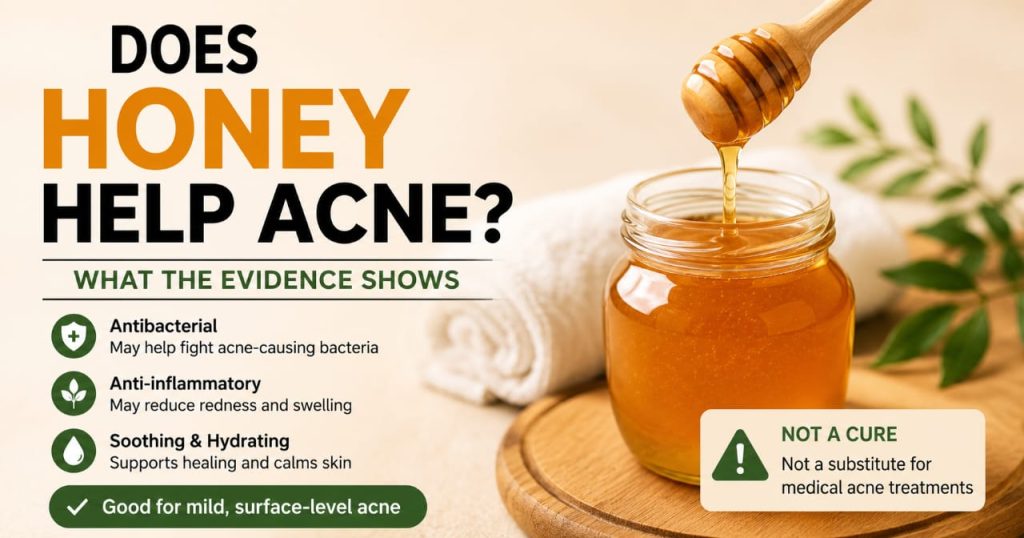
Honey has been used in skincare for centuries because of its natural antibacterial and anti-inflammatory properties. For people dealing with occasional breakouts, does honey help acne is one of the most common questions. While research suggests honey may soothe mild inflammation, it should be viewed as a supportive skincare ingredient rather than a replacement for proven acne treatments.
Honey shows up constantly in acne home-remedy content, but the honest answer is more nuanced than a simple yes or no. Honey does have real antibacterial and anti-inflammatory properties, and there’s a reasonable scientific basis for why it could help calm acne-prone skin. What it isn’t is a proven acne treatment, and the clinical evidence specifically showing it clears breakouts is limited, well short of what’s been shown for established treatments like benzoyl peroxide, salicylic
acid, or retinoids.
This guide covers what honey can realistically do for acne, which acne types it may help with, how it compares to actual acne treatments, and when it’s time to see a dermatologist instead.
Table of Contents
- Quick Answer
- How Honey May Help Acne
- Does Honey Help by Acne Type
- What Honey Won’t Do
- Raw vs Manuka Honey for Acne
- How to Use Honey for Acne
- Results Timeline
- When to See a Dermatologist Instead
- Common Mistakes
1 0. Frequently Asked Questions
1 1 . Final Thoughts
Quick Answer
Honey may help mild, surface-level acne and inflammation thanks to its
antibacterial and anti-inflammatory properties, and it can be a gentle, low-risk addition to a skincare routine for people with sensitive or reactive skin. However, clinical evidence specifically proving honey treats acne is limited, it isn’t shown to help fade acne scars, and it isn’t a substitute for dermatologist-recommended treatments for persistent, hormonal, or cystic acne.
Does honey help acne enough to replace conventional acne products? Based on current evidence, the answer is no. Honey may help reduce redness and soothe mild inflammation, but it should be viewed as a supportive skincare ingredient rather than a primary acne treatment. People with persistent or severe acne usually benefit more from evidence-based treatments recommended by a dermatologist.
How Honey May Help Acne
Honey’s plausible benefit for acne comes down to a few genuine properties:
Antibacterial activity. Raw honey produces hydrogen peroxide through natural enzymatic activity, which has some ability to inhibit bacteria, including acne-related bacteria, though this effect is milder than dedicated acne treatments.
Anti-inflammatory effects. Honey may help calm the redness and swelling associated with inflamed pimples, offering soothing rather than curative benefit.
Emollient, moisture-retaining properties. As a humectant, honey helps keep the skin’s surface hydrated, which can support the healing process around existing blemishes without adding excess oil for most people.
Dermatologists who discuss honey’s role in acne care generally frame it the same way: plausible, mild, supportive, not a primary treatment.
Does Honey Help by Acne Type
| Acne Type | Honey’s Likely Effect | Recommendation |
Whiteheads | May help calm surroundinginflammation | Reasonable to try as a gentle addition |
| Acne Type | Honey’s Likely Effect | Recommendation |
Blackheads | Limited effect; honey doesn’t unclog pores | Combine with proper cleansing and exfoliation |
| Papules (small red bumps) | May help soothe redness | Reasonable spot treatment option |
| Pustules (pus-filled pimples) | May provide mild, temporary calming | Patch test first; not a substitute for treatment |
| Nodules (deep, painful bumps) | Very limited effect | Dermatologist consultation recommended |
Cystic acne | Not shown to meaningfully help | Medical treatment recommended, not a home remedy situation |
What Honey Won’t Do
It’s worth being direct about this, since a lot of content online overstates honey’s role:
- It won’t unclog pores the way a chemical or physical exfoliant does, so
blackheads and closed comedones generally won’t respond much to honey alone.
- It’s not shown to fade acne scars. Multiple reviewed sources specifically note there’s no evidence supporting honey for scar improvement, despite this
claim circulating widely.
- It doesn’t address hormonal acne, which is driven by internal factors honey has no ability to influence.
- It won’t replace evidence-based acne treatments like benzoyl peroxide,
salicylic acid, or retinoids for anyone dealing with persistent or moderate-to-severe acne.
- It’s not a fast fix. Any calming benefit tends to be gradual and mild, not a dramatic overnight transformation.
Raw vs Manuka Honey for Acne
| Type | Notes for Acne |
Raw Honey | Retains natural enzymes and hydrogen peroxide production; a reasonable, affordable starting point |
ManukaHoney | Higher, more consistently documented antibacterial activity due to methylglyoxal content; often preferred specifically forinflamed or irritated acne |
| ProcessedHoney | Largely loses its beneficial enzyme content during heating and filtering; not recommended for this purpose |
For anyone specifically targeting inflamed, acne-prone skin, Manuka honey
(ideally UMF 1 0+ or MGO 250+) is the more evidence-backed choice, though raw honey is a reasonable, lower-cost starting point for milder concerns. Our full best honey for face guide covers UMF and MGO ratings in more detail.
How to Use Honey for Acne
- Cleanse your face gently, avoiding harsh scrubbing that can further irritate active breakouts.
- Apply a thin layer of raw or Manuka honey directly to affected areas, or across the full face as a mask.
- Leave it on for 1 0 to 20 minutes for a standard mask, or longer as a targeted spot treatment on an individual blemish.
- Rinse thoroughly with lukewarm water.
- Follow with a normal, non-comedogenic moisturizer.
- Use two to three times a week rather than daily, to avoid unnecessary buildup and to properly monitor your skin’s response.
For full application steps, timing by use case, and daily-use guidance, see our companion guides: how to apply honey on face, how long should you leave honey on your face, and can I apply honey on my face every day.
Many people searching does honey help acne are hoping for a fast natural cure. In reality, any improvement is usually gradual and depends on the type and severity of acne. Honey may calm irritated skin in some cases, but it is unlikely to clear ongoing breakouts on its own
Results Timeline
First use: Skin may feel calmer and more hydrated immediately after rinsing, largely from honey’s moisturizing effect.
Week 1 : Some people notice mildly reduced redness around existing blemishes, though this varies significantly between individuals.
Weeks 2-4: With consistent use, mild acne may show some improvement in appearance and irritation, though this is not a guaranteed outcome, and moderate-to-severe acne is unlikely to show meaningful change from honey alone.
No improvement after several weeks, or acne that’s worsening: This is a reasonable point to stop relying on honey and consult a dermatologist, particularly if breakouts are painful, deep, or affecting your confidence.
When to See a Dermatologist Instead
Honey is a reasonable, low-risk addition to a routine for mild, surface-level
irritation, but it’s worth seeing a dermatologist rather than continuing to rely on home remedies if:
Your acne is cystic, nodular, or notably painful
Breakouts are persistent despite weeks of consistent skincare
You suspect hormonal acne, which often clusters around the jawline and doesn’t respond to topical remedies alone
Acne is leaving noticeable scarring or dark marks
Over-the-counter or home approaches, including honey, haven’t produced meaningful improvement
A dermatologist can offer evidence-based treatments, including topical or oral medications, that have significantly stronger clinical support than honey or other natural remedies.
Common Mistakes
Expecting honey to replace prescribed or evidence-based acne treatment — it’s a supportive addition at best, not a primary treatment
Using processed, heavily filtered honey — this largely loses the enzyme activity that makes raw or Manuka honey potentially useful
Applying honey to broken, actively infected, or open skin — this increases irritation risk rather than helping
Skipping a patch test — even gentle ingredients like honey can cause a reaction in some people
Stopping prescribed acne medication in favor of honey — never discontinue a dermatologist-recommended treatment without medical guidance
Expecting scar improvement — current evidence doesn’t support honey as a scar-fading treatment, so this shouldn’t be the goal
Honey has been used in skincare for centuries because of its natural antibacterial and anti-inflammatory properties. For people dealing with occasional breakouts, does honey help acne is one of the most common questions. While research suggests honey may soothe mild inflammation, it should be viewed as a supportive skincare ingredient rather than a replacement for proven acne treatments.
Frequently Asked Questions
Does honey really help acne?
It may offer mild, supportive benefit for surface-level inflammation and redness, thanks to genuine antibacterial and anti-inflammatory properties, but clinical
evidence proving it treats acne is limited, and it isn’t a substitute for established treatments.
Which honey is best for acne?
Manuka honey, ideally UMF 1 0+ or MGO 250+, is generally considered the stronger option due to its more consistently documented antibacterial activity, though raw honey is a reasonable, more affordable starting point.
Can I apply honey directly to pimples?
Yes, applying a small amount directly to an individual blemish as a spot treatment is a common approach, generally left on for 20 minutes to an hour.
Can honey remove acne scars?
No, current evidence doesn’t support honey as an effective treatment for acne scars specifically, despite this claim appearing frequently online.
Can honey make acne worse?
It’s uncommon, but possible, particularly if you have a bee product allergy or apply it to already irritated, broken skin. A patch test helps catch this before it affects your whole face.
Is honey safe for oily skin?
Generally yes, in a thin layer, though very oily skin may prefer a lighter application to avoid feeling heavy.
Does honey help hormonal acne?
Not meaningfully. Hormonal acne is driven by internal factors that a topical ingredient like honey has no real ability to address.
Is Manuka honey worth it specifically for acne?
For inflamed, acne-prone skin, its stronger antibacterial documentation makes it a reasonable upgrade, though it’s still a supportive addition rather than a proven treatment.
When should I see a dermatologist for acne instead of trying home remedies? If your acne is cystic, painful, persistent despite consistent care, or causing scarring, it’s worth consulting a dermatologist rather than relying on honey or other home remedies alone.
Another reason people ask does honey help acne is because they want a gentle alternative to stronger products. While honey is generally well tolerated, it works best as part of a complete skincare routine that includes gentle cleansing, moisturizing, and sun protection instead of being used alone.
Can I use honey every day for acne?
Two to three times a week is a more common recommendation than daily use, partly to properly monitor how your skin responds. See our daily use guide for more detail.
If you’re still wondering does honey help acne, the most balanced conclusion is that it can support a healthy skincare routine but should not replace proven acne medications. Choosing raw or Manuka honey, performing a patch test, and keeping realistic expectations are all important for anyone considering this natural remedy.
For evidence-based acne treatment recommendations, see the American Academy of Dermatology.
You can also read the Mayo Clinic’s acne guide for more information on acne causes and treatment options.
Final Thoughts
Does honey help acne? Somewhat, for some people, in a supportive, mild way, but it isn’t the natural cure it’s often presented as online. Its genuine antibacterial and anti-inflammatory properties make it a reasonable, low-risk addition to a skincare routine for mild irritation, particularly for sensitive skin that reacts poorly to stronger treatments. For anything beyond mild, surface-level concerns, especially cystic or persistent acne, evidence-based treatments and a dermatologist’s
guidance remain the more reliable path.
Dermatologists generally agree that does honey help acne is not a simple yes-or-no question. Honey may provide soothing benefits for mild inflammatory acne because of its natural antibacterial and anti-inflammatory properties, but current research does not support using it as a replacement for clinically proven acne treatments. Combining honey with a gentle skincare routine is often a more realistic approach.
Before asking does honey help acne, it’s also important to identify the type of acne you have. Whiteheads, blackheads, hormonal acne, and cystic acne respond differently to treatment. While honey may temporarily calm redness or irritation in some people, deeper or persistent acne usually requires professional medical advice and evidence-based skincare products for the best results.
For more on choosing and using honey effectively, see our guides on is honey good for your face and best honey for face.
Disclaimer: This article is for general informational purposes and is not a substitute for professional medical advice. If you have persistent, painful, or severe acne, consult a dermatologist. Individual skin reactions vary, and a patch test is recommended before trying any new ingredient.